


Optimising Muscle and Tendon Adaptations with Isometric and Plyometric Training

Updated: 23 hours ago
What Stiffness Actually Means
The concept of stiffness is frequently misunderstood in athletic contexts. People associate it with a coach telling a pitcher to relax their shoulder, or with an overly muscular athlete who lacks mobility, or simply with the feeling of needing a good stretch. In reality, the term is borrowed from material engineering and physics. When applied to biological tissue, stiffness refers to a tissue's resistance against both internal and external force applications — a mechanical property that can be measured at multiple organizational levels in the human body, from isolated muscle and tendon fibers to specific joints and whole-body locomotion patterns.
When we refer to active muscle stiffness, we mean the muscle's ability to maintain an isometric contraction. Tendon stiffness refers to the tendon's ability to resist being stretched. Muscles and tendons are arranged in series within the muscle-tendon unit, so the tendon must transfer whatever force the muscle produces and therefore experiences similar force transmission, with minor differences due to lateral and shear force components.
Research by Jakubowski and colleagues (2023) examining the Achilles tendon of healthy adults revealed something important: even at low contraction intensities, muscle stiffness exceeds tendon stiffness. If the reverse were true — if muscle stiffness were lower than tendon stiffness — the tendon could never be adequately stretched, and the system would fail to store elastic energy during rapid stretch-shortening cycles. Because the muscle is always stiffer than the tendon, it can pull on the tendon effectively. But if the tendon is too compliant, ankle joint stiffness — sometimes called dynamic stiffness or joint impedance — will be compromised. In short, tendon stiffness is the limiting variable in the system.
How Muscles and Tendons Actually Behave During Movement
During dynamic movement, the changes occurring within the muscle-tendon unit are not uniform across its components. In vivo imaging studies tracking fascicle length changes in the soleus and the triceps surae muscle-tendon unit during running have produced findings that challenge the conventional picture: during what should be the eccentric phase of a stretch-shortening cycle, the muscle was actually operating in a concentric mode, while the Achilles tendon underwent lengthening to amplify power output. Similarly, the vastus lateralis remained relatively isometric during the stance phase of running, while the patellar tendon elongated to store elastic energy (Lichtwark et al., 2007).
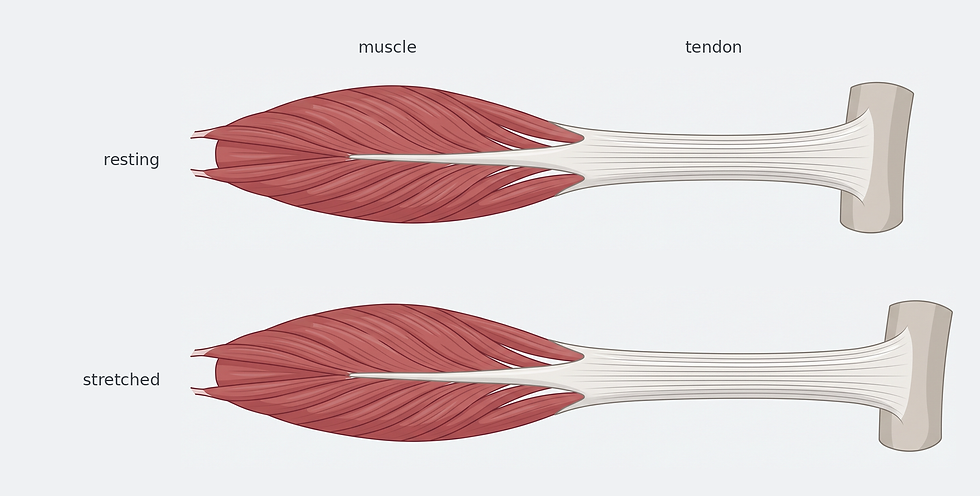
This means that during rapid stretch-shortening cycles, the muscle does not actually undergo eccentric contraction. Instead, it holds an isometric state so that the tendon can stretch and store elastic energy. There is a logical implication here: if the muscle does enter an eccentric contraction during a rapid stretch-shortening cycle, it indicates that the load is too high for the muscle to maintain its isometric state. When that happens, the tendon cannot store elastic energy efficiently, and the risk of muscle injury rises substantially.
This behavior has direct implications for mechanical efficiency. By remaining relatively isometric, the muscle reduces its metabolic cost while allowing the tendon to handle energy storage and return. This is particularly relevant for sprinting, jumping, and other high-speed movements. A stiffer tendon amplifies this advantage: while a compliant tendon can be stretched more easily, a stiff tendon stores a greater amount of elastic energy when stretched to a given magnitude. Stiffer tendons are also inherently stronger and resist excessive strain at a given load, which directly reduces injury risk.
Training the Tendon: The Role of Load Duration
Tendon adaptations are highly specific to the type of mechanical load applied. Tendons like the patellar and Achilles are primarily exposed to tension during locomotion, whereas tendons like the supraspinatus experience predominantly compressive loads. For effective tendon adaptation, the evidence indicates that training must involve high load intensity, high localized tendon strain, and a slower rate of loading sustained for a sufficient duration.
This last factor — duration of loading — is often overlooked in practice. Plyometric and sprint-based activities can induce high strain in the tendon, but this strain is extremely brief. The tendon is stretched and recoils almost instantaneously, meaning it does not experience prolonged tension. As a result, the stimulus for improving tendon stiffness is limited. This was demonstrated directly in a study that observed no improvement in tendon stiffness or cross-sectional area after nine weeks of running training in untrained subjects. By contrast, Bohm and colleagues (2015) reported significant improvements in tendon stiffness after 12 weeks of resistance training, which subjects the tendon to sustained tension under high load for longer periods.
Subsequent reviews have reinforced this principle: activities characterized by high load and slower rates of loading — such as heavy resistance training or isometric training — produce greater tendon stiffness gains than high-velocity activities. For practitioners aiming to improve tendon mechanical properties as part of an athletic development program, this has clear implications for exercise selection and session design.
"During rapid stretch-shortening cycles, the muscle does not actually undergo eccentric contraction. Instead, it holds an isometric state so that the tendon can stretch and store elastic energy."
The Case for Isometric Training
Given that both heavy dynamic resistance training and isometric training provide a similar stimulus for tendon adaptation, why choose isometric training? There are several practical and physiological reasons.
Safety is the first. Isometric training involves no external movement, which inherently reduces injury risk. Research has also shown that recovery from maximal isometric training is faster than recovery from heavy dynamic resistance training, which allows for greater training frequency without accumulating unmanageable fatigue.
Joint-angle specificity is the second. Isometric training allows practitioners to target force production at specific joint angles — useful when an athlete needs to address a weakness at a particular position in a movement, such as the sticking region in a squat or press.
Training volume is the third. Because isometric contractions can be performed repeatedly at maximum intensity within the same session — something that is not feasible with heavy external loads — the cumulative stimulus for tendon and muscular adaptation can be substantial.
The neural adaptations produced by isometric training closely parallel those of heavy resistance training: greater voluntary activation, increased motor unit recruitment, decreased antagonist co-contraction (where the opposing muscle group creates internal resistance), and improved synchronization of motor unit firing. Morphological adaptations include increases in muscle cross-sectional area ranging from 5 to 23% over periods of six weeks to 100 days (Lum and Barbosa, 2019).
The degree of hypertrophy achieved depends meaningfully on contraction duration. Research by Schott and colleagues (1995) showed that four sets of 30-second contractions produced greater hypertrophy than four sets of ten 3-second contractions, even when total time under tension was identical at 120 seconds in both conditions. A longer, uninterrupted contraction appears to be more effective for hypertrophy than the same total volume distributed across many short efforts.
Joint position during isometric training also influences the outcome. Training at longer muscle lengths — for example, at a 90-degree knee angle rather than 120 degrees during isometric leg extension — produces greater strength gains across a wider range of motion, stimulates more hypertrophy, and generates greater tendon stiffness gains. This is because the longer muscle length places more stretch on both the muscle and the associated tendon, increasing the mechanical stimulus. When the primary goal is power development and only isometric training is being used, training at multiple joint angles is recommended to ensure force production capacity is developed across the full movement range.
Pushing Isometrics and Holding Isometrics: Two Distinct Modalities
Isometric actions can be divided into two distinct types with different motor control profiles and adaptive outcomes.
Pushing Isometrics Muscle Action (PIMA) involve pushing or pulling against an immovable object — the athlete generates force without any resulting movement. Holding Isometrics Muscle Action (HIMA) involve maintaining a fixed position while resisting an applied external force — the athlete is not initiating force but preventing displacement.
Research suggests that limb muscles can sustain a given force for longer during push isometrics, while trunk muscles can sustain force longer during hold isometrics (Lum and Barbosa, 2019). This likely reflects the evolutionary specialization of trunk muscles for postural maintenance — a fundamentally hold-isometric function — while limb muscles are designed for pushing and pulling movements.
An unpublished study comparing PIMA and HIMA when matched for intensity (70% MVC) and duration (20 seconds per repetition, four to six repetitions) found that PIMA produced greater strength gains, while HIMA induced greater hypertrophy (D. Lum, unpublished data). This gives practitioners a practical decision framework: when the goal is maximum strength development, PIMA is the more appropriate choice; when the goal is muscle size, HIMA should be favoured.
Evidence for Athletic Performance Outcomes
A growing body of research shows that isometric training improves sport-relevant performance outcomes, not only isolated strength measures.
In a study comparing isometric training to plyometric training in endurance runners, both modalities improved 2.4 km time trial performance and maximum aerobic speed. However, only the isometric training group showed improvements in running economy (reviewed in Lum and Barbosa, 2019). The likely explanation is that plyometric training closely resembles the stretch-shortening cycle demands of running, providing a less novel stimulus to runners already adapted to that pattern. Isometric training, being a mechanically distinct mode of loading, produced a new adaptive signal that transferred to running efficiency in a way plyometric training did not.
In a separate study with kayak athletes, those who included isometric training alongside traditional resistance training showed greater improvements in 200-metre time trial power output and greater peak force gains in both squat and bench press compared to athletes who trained with resistance training alone (reviewed in Lum and Barbosa, 2019).
A 24-week training study examined the long-term effects of integrating isometric training within a resistance training program across three groups: a control group performing only heavy resistance training; a group that continuously substituted half of their dynamic squat volume with isometric squats for the full 24 weeks; and a group that made this substitution for only the first 12 weeks. The 24-weeks group outperformed both other groups on sprinting, jumping, and isometric mid-thigh pull performance. The 12-weeks group outperformed the control group as well (reviewed in Lum and Barbosa, 2019). These results indicate that isometric training can be incorporated over extended periods without impeding performance and, in several measures, produces superior adaptations compared to traditional resistance training alone.
Combining Isometric and Plyometric Training
While isometric training effectively improves tendon stiffness, it is not the primary tool for developing active muscle stiffness — the muscle's capacity to maintain an isometric state during a rapid stretch-shortening cycle. Plyometric training is more appropriate for this purpose. The rapid stretch-shortening cycle inherent in plyometric exercises forces the muscle to stiffen and remain in a relatively isometric state, which is precisely the quality needed for efficient tendon energy storage and return during high-speed movements.
Plyometric exercises fall into two categories based on ground contact time. Fast or short-response plyometrics involve contact times under 250 milliseconds and are effective for improving reactive strength. Slow or long-response plyometrics involve contact times greater than 250 milliseconds and are used to develop fast dynamic strength.
The most productive approach combines both modalities strategically, pairing isometric and plyometric exercises that share similar biomechanical profiles. An isometric trap bar deadlift, for example, pairs well with a squat jump or box jump; an isometric split squat pairs well with a split squat jump or single-leg drop landing. These pairings can be structured as contrast sets — performing the isometric exercise immediately followed by the plyometric within the same set — or as separate blocks where all isometric sets are completed before the plyometric work begins.

Programming recommendations change based on the training phase:
During a general strength phase focused on hypertrophy and foundational strength, HIMA at 70% MVC held for 20 to 25 seconds is appropriate, paired with low-intensity plyometric work.
During a maximal strength phase, PIMA at 100% MVC for three sets of 10-second contractions or multiple repetitions of shorter contraction duration (e.g. two to three repetitions of five seconds) can be paired with drop jumps or countermovement jumps.
When the goal shifts to developing both maximal and explosive strength simultaneously, PIMA should be performed as rapidly as possible with each contraction sustained for no more than three seconds — because longer sustained contractions at maximum intensity can interfere with rate of force development by inducing neuromuscular fatigue in fast-twitch motor units.
In a power phase, contraction rate is maximized, repetitions per set are reduced to two or three, and each contraction is sustained for just one to two seconds to ensure minimal fatigue and maximum explosive output.
Summary
Isometric and plyometric training address different aspects of the same muscle-tendon system. Isometric training — whether PIMA or HIMA — provides a sustained high-load stimulus that drives tendon stiffness adaptations and meaningful gains in muscular strength and hypertrophy, with the specific outcome depending on the intensity and duration protocols used. Plyometric training develops the active muscle stiffness needed to exploit tendon elasticity during high-speed movements, an adaptation that isometric training cannot fully replicate.
Used together with appropriate programming, these two modalities improve sprinting, jumping, running economy, and sport-specific power in ways that neither approach achieves alone. The evidence across multiple athletic populations is consistent on this point, and the practical application — pairing exercises with matched biomechanical profiles, adjusting intensity and duration by training phase — is straightforward enough to integrate into most existing training structures.
---
Frequently Asked Questions
Q: If tendons need sustained tension to adapt, does that mean plyometric training provides no tendon benefit at all?
Not quite — plyometric training does place the tendon under high strain, which has some adaptive value. The limitation is that this strain is extremely brief; the tendon is stretched and recoils in milliseconds, so it does not experience the prolonged mechanical tension that research associates with improvements in tendon stiffness. A study that tracked nine weeks of running training in untrained subjects found no change in tendon stiffness or cross-sectional area. The adaptive signal for tendon stiffness comes primarily from sustained loading under high force, which is why isometric or heavy resistance training should not be removed from a programme in favour of plyometric work alone.
Q: What is the practical difference between PIMA and HIMA in terms of how they feel to perform?
In push isometrics, the athlete actively generates force against an immovable object — a barbell pinned against a safety rack, for example. The effort is outward. In hold isometrics, the athlete holds a fixed position while a force is applied to them — a partner pushing against a limb, or gravity being resisted in a loaded position. The effort is inward, stabilizing against displacement. The adaptive outcomes differ too: PIMA produces greater strength gains, HIMA produces greater hypertrophy, even when matched for intensity and total time under tension.
Q: Is there a risk that long-term isometric training reduces dynamic movement quality?
A 24-week study directly addressed this concern by replacing half of the dynamic squat volume with isometric squats across the full training period. Rather than reducing dynamic performance, this group outperformed the resistance-training-only control on sprinting and jumping measures. The key is appropriate programming: isometric training is paired with plyometric work that maintains the stretch-shortening cycle stimulus, and the two modalities complement rather than compete with each other.
Q: Why does training at longer muscle lengths produce better strength and hypertrophy outcomes?
A longer muscle length places greater stretch on both the contractile elements of the muscle and the associated tendon, increasing the mechanical stimulus to which both structures are exposed. This results in greater activation of satellite cells for hypertrophy and a more distributed tensile load across the tendon, improving stiffness gains more broadly. For athletes using only isometric training for power development — without accompanying dynamic resistance work — training at multiple joint angles is recommended to cover the full strength curve.
Q: How should isometric and plyometric exercises be paired within a session?
The most effective approach is to match exercises with similar biomechanical profiles. An isometric trap bar deadlift pairs with a squat jump or box jump; an isometric split squat pairs with a split squat jump or single-leg drop landing. These can be performed as contrast sets — isometric immediately followed by plyometric — or as sequential blocks. Contrast pairing tends to work well when the primary goal is power expression, since the isometric pre-activation may potentiate the subsequent explosive output.
References
Lum, D., & Barbosa, T. M. (2019) 'Brief Review: Effects of Isometric Strength Training on Strength and Dynamic Performance', International Journal of Sports Medicine, 40(6), 363–375.
Bohm, S., Mersmann, F., and Arampatzis, A. (2015) 'Human tendon adaptation in response to mechanical loading: a systematic review and meta-analysis of exercise intervention studies on healthy adults', Sports Medicine Open, 1(1), 7.
Kubo, K., Kanehisa, H., and Fukunaga, T. (2001) 'Effects of isometric training on the elasticity of human tendon structures in vivo', Journal of Applied Physiology, 91(1), 26–32.
Schott, J., McCully, K., and Rutherford, O. M. (1995) 'The role of metabolites in strength training. II. Short versus long isometric contractions', European Journal of Applied Physiology, 71(4), 337–341.
Lichtwark, G. A., Bougoulias, K., and Wilson, A. M. (2007) 'Muscle fascicle and series elastic element length changes along the length of the human gastrocnemius during walking and running', Journal of Biomechanics, 40(1), 157–164.
Jakubowski, K. L., Ludvig, D., Perreault, E. J., and Lee, S. S. M. (2023) 'Non-linear properties of the Achilles tendon determine ankle impedance over a broad range of activations in humans', Journal of Experimental Biology, 226(14).

Danny Lum is the Head of Strength and Conditioning at the High Performance Sport Institute in Singapore. Danny is in charge of the strength and conditioning program for Singapore’s national athletes from multiple sports, including diving, grappling sports, kayaking, and track cycling. He is also actively conducting research to better understand the effects of isometric training on sports performance and the post-activation performance enhancement effects of various warm-up protocols.


Comments