


Genes Before Speed: Train the Engine You Actually Have

Updated: 23 hours ago

Power is the most desirable quality in sport. It can be the difference maker at the elite level and a massive competitive advantage at every level below it. For too long there has been a myth that power cannot be trained, either you have it or you don't. That myth costs athlete’s development time they will never get back.
Let's start with the basics. Power is your ability to express force fast: the sprint out of the blocks, the jump, the first explosive step, the finishing kick at the end of a 1500 meters, the watts a cyclist puts out on a climb. Power lives in speed sports, but it lives in endurance sports too. Any time an athlete must produce force under fatigue or against a clock; power is in the equation. Your genes set the baseline. Your training decides what you do with it.
Pathways, not Lists of Genes: What Makes 3X4 Genetics Different for Coaches
Most genetic testing in sport looks at individual variants in isolation. One gene, one trait, one recommendation. Coaches who have tried to use raw genetic data know the problem immediately: a list of gene results is hard to interpret, harder to explain to an athlete, and almost impossible to translate into a training decision on the spot.
3X4 Genetics is built differently. Our methodology, powered by a patented engine called DARWIN, reads gene variants across 36 biological pathways simultaneously. A pathway is a coordinated system of biochemical and metabolic processes including muscle architecture, energy production, inflammation management, connective tissue integrity, and more. DARWIN calculates a score for each pathway that reflects how multiple variants interact within that system. The output is not a gene list. It is a clear, actionable profile of how an athlete's biology is organized.

That distinction matters enormously for coaches. For instance: instead of trying to explain to an athlete what their ACTN3 genotype means, you can tell them their muscle fiber type pathway is strong- they are built to express power, while their recovery pathway needs support, and here is what that means for how we are going to train and recover this week. The complexity stays under the hood. What comes out the other side is something a coach can use on day one and something an athlete can understand in a single conversation.
Applied to power development, the question is not whether an athlete carries a specific variant. It is this: across the pathways that govern how they build, express, and recover from power, where is the capacity, where are the constraints, and where should the training go?
The Hardware: Fast Twitch Is the Foundation
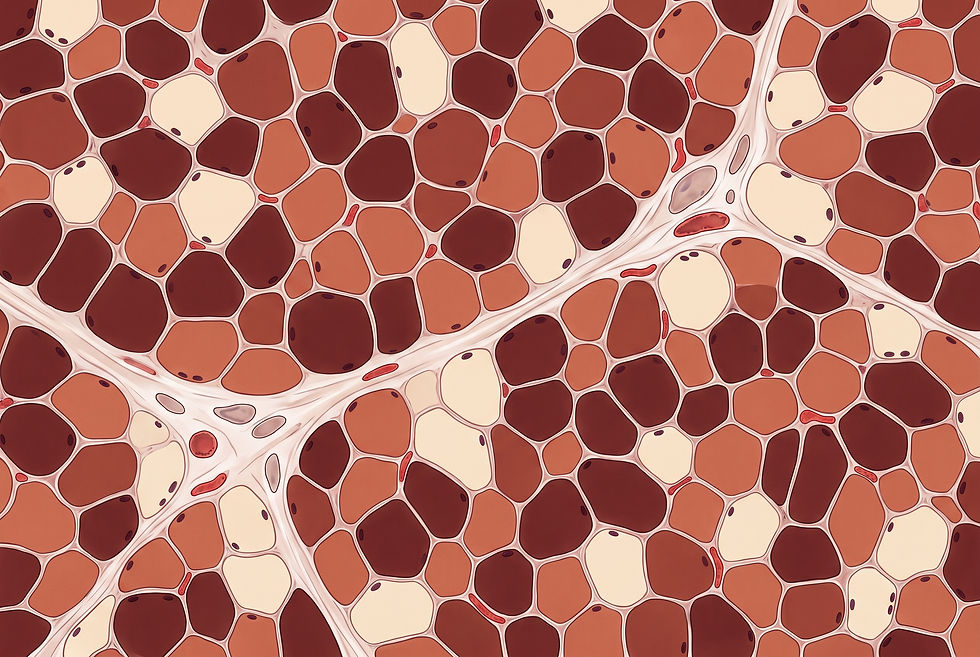
Fast twitch fibers contract faster than their slow twitch counterparts and tend to be larger, with more room to grow under the right training. They are the physical basis of high force and speed. The muscle fiber pathway score reflects how an athlete is built to express power, drawing on variants including ACTN3 and ACE, among others. ACTN3 codes for alpha-actinin-3, a structural protein found almost exclusively in fast twitch fibers, which is why it is so closely tied to explosive performance. ACE codes for an enzyme best known for regulating blood pressure, but its common variants also track with whether an athlete leans toward power or endurance. Those variants are inputs to the pathway score, not the finding itself, but it helps to understand what they contribute.
ACTN3 carries the strongest individual evidence in sports genetics. A 2024 meta-analysis of over 14,500 participants confirmed that the R allele is significantly more common in elite power athletes than in endurance athletes or non-athletes (El Ouali et al., 2024). ACE leans the same direction. Its D form is associated with greater muscle volume and a fast twitch bias, while the I form tracks with endurance. Neither of these variants tells the full story on its own. What DARWIN does is read them together, alongside other variants that touches that pathway, and produce a single score that is far more informative than any individual result. Keeping in mind that each genetic variant needs to have enough scientific evidence to be included in considered in DARWIN.
For a coach, a strong muscle architecture pathway score means one thing practically: explosive work is likely to pay off. The athlete is built to respond to it. A moderate or lower score does not mean power is off the table. It means the program needs to be more focused and deliberate about building and protecting every gain.
Two further coaching points. Fiber type proportion is meaningfully heritable - familial and twin studies put the genetic contribution around 45 to 50 percent (Simoneau and Bouchard, 1995; Ahmetov et al., 2012), depending on methodology. But heritable does not mean fixed. Training changes how the fibers you already have behave. A power biased athlete still has to be taught to actually use that fast twitch potential, through intent, ballistic work, and high quality, low fatigue sets. Turning that potential into performance is the whole job of the program.
The Fuel and the Trigger: Force On Demand
Explosive work is anaerobic work. It happens faster than oxygen can arrive. A second set of pathways governs how efficiently an athlete produces energy without oxygen, how well they sustain repeated maximal efforts, and how the body manages the inflammatory cost of hard training. DARWIN reads variants including AMPD1, PPARA, NOS3, and IL6 when scoring these pathways. AMPD1 codes for an enzyme that helps muscle generate energy during short, high intensity efforts, which is why a common loss-of-function variant can blunt anaerobic capacity. PPARA codes for a regulator of how the body uses fuel for energy, and its variants lean an athlete toward either power or endurance. NOS3 codes for the enzyme that produces nitric oxide, which controls blood flow and oxygen delivery to working muscle. IL6 codes for a signaling molecule central to inflammation and the recovery response after hard training. Again, no single variant here tells the full story. The PPARA C allele, for instance, is over-represented in strength and power athletes in the literature and has been linked to higher anaerobic power output, but its value in this methodology is what it contributes to the pathway score alongside everything else in that system. For the performance team, this is where recovery strategy lives. Recovery is where power is either protected or quietly given away. The practical utility here is direct. Instead of applying the same recovery protocol to every athlete, a coach can look at the anaerobic and post training inflammation pathway scores and immediately see where each athlete is most likely to bottleneck. The athlete who scores high on inflammatory load is not weak or undertrained. Their biology accumulates tissue stress faster and clears it more slowly, and the program needs to reflect that. Hard anaerobic work on Monday may genuinely require protected recovery before Thursday, not as a preference, but as a biological requirement.
The pathway score makes that conversation easy. You are not telling an athlete they have a specific gene variant and hoping they understand what that means. You are telling them their recovery pathway needs more support than average, and here is how we are going to build that into the week. Athletes accept that. They act on it.
The modality follows the pathway. A high inflammatory load profile responds best to a targeted nutrition base: anti-inflammatory foods, omega 3s, polyphenols, well timed protein, and sleep treated as a training session rather than an afterthought. An oxidative stress prone profile points toward whole food antioxidant support, careful timing around the hardest training blocks, and patience with the recovery window. Technology earns its place when it is aimed at a known weakness rather than applied uniformly. Compression, controlled temperature contrast, and load monitoring tools keep accumulated fatigue in check. Manual therapy and soft tissue work close the loop on tissue tolerance. In most athletes the right answer is a combination of these, sequenced to the pathways DARWIN flagged. Ignore the recovery half and you cap the very quality you are trying to build.
"Power lives in speed sports, but it lives in endurance sports too. Any time an athlete must produce force under fatigue or against a clock; power is in the equation. Your genes set the baseline. Your training decides what you do with it."
The Big Picture: No Single Gene Decides
This is the part I most want coaches to internalize. There is no power gene. A meta-analysis of more than 5,800 power athletes identified a core set of variants reliably tied to power athlete status, and the signal is unambiguously polygenic (Weyerstrass et al., 2018). Reading those variants one at a time and trying to add up the results does not give you the same picture that a coordinated pathway score does. The interaction between variants within a pathway matters. That is precisely what DARWIN is designed to capture, and it is precisely why the output is more useful to a coach than a raw genetic report.
Just as important: the power pathway is narrower than the word suggests. It reads fast twitch fiber character and anaerobic energy supply. It does not read strength. Those are related but distinct constructs. Power is a work rate, measured in watts. Strength is force, the capacity to overcome resistance, measured in newtons. An athlete can be well built for one and unremarkable at the other.
That distinction changes how a block gets built. Two athletes can post identical vertical jumps and arrive there by different routes. One has the fiber type and anaerobic machinery to express high velocity natively. The other is producing the same number through force capacity built in the gym. The pathway profile tells a coach which athlete is in front of them on day one instead of burning a mesocycle finding out the hard way. It narrows the search space on the fiber and anaerobic side. It says nothing about the force side, and it does not replace the search.

Training to the Profile
Build the program around the athlete's genetic strengths, not the averages. Early research suggests that when training is matched to genetic profile, athletes show greater gains, and that mismatched programs produce more low responders (Jones et al., 2016).
In practice the profile shapes emphasis and expectation more than it dictate exercise selection. A higher power pathway score means explosive work pays off quickly. You can lean into plyometrics, contrast and complex methods, and Olympic lift derivatives. Volume can stay relatively low while intensity stays high, because the responsiveness is there to reward it. A lower power pathway score means power is built steadily and with a slower progression. You program it patiently, you respect the loading and recovery that protect each gain, and you do not mistake a slower curve for a low ceiling. The athlete who builds power gradually often holds it better, because the supporting tissue and the technical base were laid down properly.
Across both profiles, one rule does not move: phenotype is the referee. Genetics personalizes the starting plan, but force plate output, sprint times, and jump performance lead. Those numbers do two jobs. First, they tell you whether the program is working. If rate of force and jump output are climbing, the plan is sound. If they stall or slide, the program needs adjustment regardless of what the pathway profile predicted. Second, they tell you how much time an athlete needs between sessions. A drop in jump height or a slower sprint the morning after hard work is not a character flaw. It is the body telling you that recovery is incomplete, and the next maximal session should wait.
Genetics describes capacity, not current state. The most genetically powerful athlete on the roster can be recovering poorly, and when they are, the force plate and the stopwatch will say so, long before the athlete admits it. A strong power pathway profile does not exempt anyone from fatigue. If anything, it masks it, because these athletes can grind through sessions they have no business completing. The testing protects them from themselves.
We use the pathway profile to ask better questions. We use the phenotype – which is how the athlete shows up to you - to answer them, day to day and block to block.
That is the 3X4 Genetics approach in a sentence: train to your pathway profile, validate with your phenotype, and expect faster and better results. Genes first, athlete led.
---
Frequently Asked Questions
Q: Is power trainable, or is it determined by genetics?
Power is trainable. Genetics sets the baseline rather than the ceiling. Familial and twin studies place the heritable contribution to fibre-type proportion at roughly 45 to 50 percent (Simoneau & Bouchard, 1995; Ahmetov et al., 2012), which leaves a substantial share to training, and heritability describes the proportion of variation attributable to genetics in a population rather than a fixed outcome for any individual. Training also changes how the fibres an athlete already has behave, so an athlete with a favourable profile still has to be taught to express that potential through intent, ballistic work, and high-quality low-fatigue sets. What differs between athletes is the starting point and the rate of progression, not whether power can be developed at all.
Q: What is the difference between pathway-based genetic analysis and single-gene testing?
Single-gene testing reports variants in isolation: one gene, one trait, one recommendation. Pathway-based analysis reads variants across coordinated biological systems — muscle architecture, energy production, inflammation management, connective tissue integrity — and calculates a score that reflects how those variants interact within each system. The practical difference is interpretability. A coach can act on the statement that an athlete's recovery pathway needs more support than average, whereas a list of genotypes generally requires further translation before it changes anything in the programme.
Q: Does a high power pathway score mean an athlete is strong?
No, and the distinction matters for programme design. Power is a work rate, expressed in watts, while strength is force, the capacity to overcome resistance, expressed in newtons. The pathways that inform power capacity read fast-twitch fibre character and anaerobic energy supply; they do not read strength. Two athletes can post an identical vertical jump with one expressing high velocity natively and the other producing the same output through force capacity built in the gym, and those two athletes may need substantially different emphases to keep improving.
Q: How should a coach use a genetic profile alongside normal performance testing?
The two serve different roles and should not be substituted for one another. Genetics describes capacity, which is useful at the start of a block for setting emphasis and expectation. Phenotype — force plate output, sprint times, jump performance — describes current state, and it decides whether the programme is working and how much time an athlete needs between sessions. A drop in jump height or a slower sprint the morning after hard work indicates incomplete recovery regardless of what the profile predicted, and a strong power profile does not exempt an athlete from fatigue. In some cases it may obscure it, because these athletes are often able to complete sessions their recovery status does not support.
Q: What does the evidence actually show about ACTN3 and power performance?
ACTN3 carries the strongest individual evidence in sports genetics. A 2024 meta-analysis of over 14,500 participants confirmed that the R allele is significantly more common in elite power athletes than in endurance athletes or non-athletes (El Ouali et al., 2024). ACE leans in the same direction, with the D form associated with greater muscle volume and a fast-twitch bias. Neither variant is informative enough on its own to guide a programme, however: a meta-analysis of more than 5,800 power athletes identified a core set of variants tied to power athlete status and found the signal to be clearly polygenic (Weyerstrass et al., 2018), which is why these variants are more usefully read as inputs to a pathway score than as standalone findings.
References
Ahmetov, I.I., Vinogradova, O.L. and Williams, A.G. (2012) 'Gene polymorphisms and fiber-type composition of human skeletal muscle', International Journal of Sport Nutrition and Exercise Metabolism, 22(4), pp. 292–303. doi: 10.1123/ijsnem.22.4.292.
El Ouali, E.M., Barthelemy, B., Del Coso, J., Hackney, A.C., Laher, I., Govindasamy, K., Mesfioui, A., Granacher, U. and Zouhal, H. (2024) 'A systematic review and meta-analysis of the association between ACTN3 R577X genotypes and performance in endurance versus power athletes and non-athletes', Sports Medicine – Open, 10(1), article 37. doi: 10.1186/s40798-024-00711-x.
Jones, N., Kiely, J., Suraci, B., Collins, D.J., de Lorenzo, D., Pickering, C. and Grimaldi, K.A. (2016) 'A genetic-based algorithm for personalized resistance training', Biology of Sport, 33(2), pp. 117–126. doi: 10.5604/20831862.1198210.
Petr, M., Maciejewska-Skrendo, A., Zajac, A., Chycki, J. and Stastny, P. (2019) 'Association of elite sports status with gene variants of peroxisome proliferator activated receptors and their transcriptional coactivator', International Journal of Molecular Sciences, 21(1), article 162. doi: 10.3390/ijms21010162.
Simoneau, J.A. and Bouchard, C. (1995) 'Genetic determinism of fiber type proportion in human skeletal muscle', FASEB Journal, 9(11), pp. 1091–1095. doi: 10.1096/fasebj.9.11.7649409.
Sommers, L., Akam, L., Hunter, D.J., Bhatti, J.S. and Mastana, S. (2024) 'Role of the ACE I/D polymorphism in selected public health-associated sporting modalities: an updated systematic review and meta-analysis', International Journal of Environmental Research and Public Health, 21(11), article 1439. doi: 10.3390/ijerph21111439.
Weyerstraß, J., Stewart, K., Wesselius, A. and Zeegers, M. (2018) 'Nine genetic polymorphisms associated with power athlete status – a meta-analysis', Journal of Science and Medicine in Sport, 21(2), pp. 213–220. doi: 10.1016/j.jsams.2017.06.012.

Daniel Guzmán is the Head of Performance for 3X4 Genetics and GENEFIT Sport, where he champions a "genes-first" approach to elite athletic training, health, and recovery. A former high-level performance coach for major clubs like LAFC, LA Galaxy, and the USMNT, he integrates genetic blueprints with real-time wearable data to customize athlete protocols. Daniel represents 3X4 Genetics with multi-club ownership (MCO) groups around the world, helping them build genes-first principles into their high-performance plans across every club in their portfolio.



Comments