


Blood Testing and Athletic Performance: Why A Single Biomarker Tells You Almost Nothing

Updated: Aug 18
In athlete monitoring, a blood biomarker is frequently evaluated the same way it is in a clinic: a single value compared against a population reference range and pronounced "normal" or "abnormal". Ferritin sits within range, testosterone is adequate, vitamin D is sufficient — and the panel is filed as reassurance. Yet this approach answers a narrow question. A reference range built from a sedentary population is designed to detect overt pathology; it is poorly suited to telling us whether an athlete is adapting to training, recovering between sessions, or drifting toward a decrement in performance that no isolated value will reliably anticipate.

The limitation is structural rather than incidental. Physiological systems do not operate as independent variables, and the body does not observe the conceptual boundaries we impose between iron status and inflammation, or between endocrine and metabolic function. The information that informs training decisions therefore resides less in any individual marker than in the relationships between markers — the patterns, ratios, and trajectories that emerge only when values are interpreted together and against an athlete's own baseline. The purpose of this article is to set out how a relational, systems-level reading of blood biomarkers can be applied in practice.
The Limits Of Population Reference Ranges In Athlete Monitoring
The standard laboratory reference range is built from a general population and defined statistically: it captures the central 95% of values in a presumed-healthy reference group. Two consequences follow, and both matter for athletes. First, the range describes what is common, not what is optimal — being inside it means only that you are not statistically unusual, not that you are functioning well. Second, the reference population is overwhelmingly sedentary, and the athlete's physiology operates at completely different set-points (Lombardi, Lanteri and Banfi, 2019).
Consider ferritin. The conventional lower bound sits around 12–15 ng/mL, a threshold designed to flag frank iron-deficiency anaemia. Yet a substantial body of work shows that endurance performance and iron-dependent mitochondrial function are already compromised at ferritin concentrations well above this — in the 30–50 ng/mL range — long before haemoglobin falls and anaemia becomes detectable on a standard CBC (Clénin et al., 2015; Sim et al., 2019). A female distance runner with a ferritin of 25 ng/mL would be classified as normal, yet at that level her iron stores are insufficient to support the demands of her sport. The reference range has not failed; it has simply answered a clinical question about disease rather than the performance question that actually concerns her.
The same logic applies across the panel. Resting heart rate, haemoglobin, creatine kinase, cortisol — every one of these has an athlete-specific distribution that diverges sharply from population norms. An elite endurance athlete with a resting heart rate of 38 beats per minute and a haemoglobin of 17 g/dL would, on paper, attract concern from a clinician reading against sedentary criteria; in context, both reflect successful aerobic adaptation. Creatine kinase presents the opposite situation: in a trained athlete who is loaded frequently, the resting baseline often exceeds the upper limit of the laboratory range. Judged against the population threshold, these routine values can appear abnormal, while the elevations that genuinely indicate incomplete recovery are harder to distinguish because the baseline is already high. The reference range is not wrong, exactly. It is answering a different question than the one a high-performance practitioner needs answered.
The practitioner's job, then, is not to ask "is this value normal?" but "is this value right for this athlete, in this training phase, relative to their own baseline and their other markers?".
The distinction matters because the two questions lead to different outcomes. Asking whether a value is normal tends to end in reassurance or concern, whereas asking whether it is appropriate for the athlete points toward a practical response: adjusting training load, restoring energy availability, investigating further, or leaving things unchanged because the value is exactly where it should be given everything else known about that athlete.
The Case Of Hepcidin: Why Iron And Inflammation Cannot Be Read Apart
The clearest illustration of why markers must be read together is the relationship between iron and inflammation, mediated by a hormone most blood panels never measure: hepcidin. Hepcidin is the master regulator of iron homeostasis, and it is also an acute-phase protein. Inflammatory cytokines — principally interleukin-6, which rises sharply with intense exercise — drive hepcidin up, and elevated hepcidin blocks intestinal iron absorption and traps iron inside macrophages (Peeling et al., 2009; Sim et al., 2019).
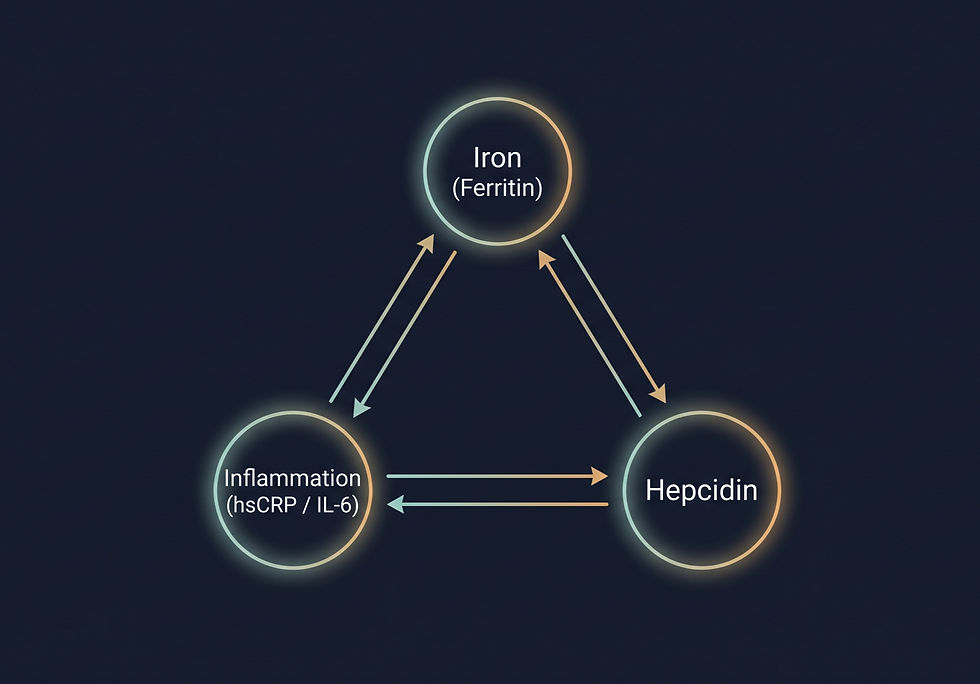
This has two practical implications that a single-marker reading tends to overlook. The first stems from ferritin being an acute-phase reactant in its own right. An athlete with genuinely depleted iron stores but concurrent inflammation may show a ferritin that appears normal, or even elevated, so reading ferritin in isolation can conceal the deficiency altogether. Interpreting it alongside high-sensitivity C-reactive protein (hsCRP) clarifies the situation: when hsCRP exceeds about 5 mg/L, a normal ferritin can no longer be taken as a reliable index of iron status, and a marker unaffected by inflammation, such as soluble transferrin receptor, is needed to establish the true picture (Clénin et al., 2015).
The second implication concerns timing. Because exercise-induced IL-6 drives a transient rise in hepcidin that peaks several hours after a session, iron taken in the evening following a hard morning workout coincides with the period when absorption is most suppressed. Supplementing instead in the morning, away from this inflammatory window and together with vitamin C to offset hepcidin's effect, is a more effective approach — but it only becomes apparent once iron is considered as part of an inflammatory system rather than as a value read on its own (Peeling et al., 2009).
The Ratio That Single Blood Biomarkers Cannot Give You
Hormonal monitoring is prone to the same reductionism, and the solution is also the same: interpret the relationship between markers rather than any single value. Total testosterone is the marker athletes tend to focus on, but on its own it conveys little, for two reasons. Only the free fraction — roughly 1–3% of the total — is biologically active, and that fraction is governed by sex hormone-binding globulin (SHBG), which rises with low energy availability and high aerobic volume. A lean, high-volume endurance athlete can carry a perfectly normal total testosterone while functionally hypogonadal, because elevated SHBG has rendered most of that testosterone inert.
More importantly, testosterone means nothing without its counterweight. The testosterone-to-cortisol ratio, proposed decades ago by Adlercreutz and colleagues (1986), remains the most practical biomarker of anabolic-catabolic balance precisely because it captures a relationship rather than a level (Adlercreutz et al., 1986). Training is a catabolic stimulus; recovery is the anabolic response. When the ratio narrows, as cortisol rises and free testosterone declines, it indicates a shift toward a catabolic state even if neither value, considered separately, has moved outside its reference range. A declining T:C ratio across a training phase, ideally more than 30% below an athlete's own baseline, is among the better-supported early signals of non-functional overreaching (Meeusen et al., 2013). No single hormone delivers this. The ratio does.
This is why the anabolic axis must be read as a cluster: free testosterone, SHBG, cortisol, and DHEAS together, against the athlete's baseline and their current training load. SHBG tells you about bioavailability and energy status; cortisol tells you about stress; DHEAS reflects adrenal reserve. Each constrains the interpretation of the others, and the cluster says something none of its members can say alone.

Context Is A Fundamental Variable
Even the right markers, read together, are difficult to interpret without context — and the most important context is training load and timing. A creatine kinase of 800 U/L is unremarkable twenty-four hours after a heavy eccentric session and alarming if it appears at rest five days into a taper. A cortisol drawn at 2 p.m. after a hard session is physiologically meaningless for trend analysis. An elevated white cell count means infection in a sick athlete and normal leukocyte mobilisation in a healthy one the morning after competition.
This is where the integration of wearable-derived load data and blood biomarkers becomes essential. Knowing that an athlete logged a 40% spike in training volume the week before a blood draw transforms a "low" testosterone reading from a red flag into an expected, appropriate response. Without that context, the same number can prompt an intervention the athlete does not need. Standardisation is what makes context usable: testing at the same time of day, fasted, at least 48 hours after intense exercise, well hydrated, and following adequate sleep. In its absence, longitudinal comparison — which is the comparison that actually matters — becomes unreliable (Lombardi, Lanteri and Banfi, 2019).
The deeper point is that the body responds to stress as an integrated system, not as a collection of independent organs. Relative Energy Deficiency in Sport (RED-S) is a good example: chronic low energy availability suppresses the hypothalamic-pituitary-gonadal axis, downregulates thyroid hormone conversion, elevates cortisol, depresses bone turnover, blunts immune function and depletes iron — simultaneously (Mountjoy et al., 2018). Its biomarker signature is a combination of findings: low T3, low LH, suppressed sex hormones, elevated cortisol, low ferritin, and low vitamin D. Individually, any one of these is easy to overlook, but together they characterise a condition serious enough to compromise an entire season. The diagnosis rests on the pattern rather than on any single marker.
Metabolic markers behave the same way. A fasting glucose, an HbA1c, a triglyceride and an HDL value each carry modest information alone, but their relationships are far more informative. The triglyceride-to-HDL ratio is a well-recognised surrogate for insulin sensitivity that neither marker conveys independently, and fasting insulin reveals the early compensatory hyperinsulinaemia of insulin resistance years before fasting glucose ever leaves its range. An athlete can present with a flawless glucose and a deteriorating metabolic state visible only in the insulin response and the lipid ratios — and even lean, highly-trained athletes are not exempt when chronic high carbohydrate intake collides with insufficient sleep and accumulating stress.
What This Changes In Practice
The shift from single-marker thinking to a systems approach has direct practical consequences. It changes which markers are ordered, when they are ordered, and how the results are acted on.

Three principles follow from it.
First, panels should be built as clusters rather than as lists of individual tests. Assessing iron also means assessing inflammation, since ferritin measured without hsCRP is an incomplete test rather than a more economical one. Assessing the anabolic axis requires free testosterone, SHBG, and cortisol together, because these values constrain one another's interpretation. Ordering markers that inform each other is not redundant; it is what makes a meaningful signal possible.
Second, the athlete's own baseline is the reference range that matters. Population norms are a coarse safety net for detecting pathology. Interpreting performance requires a personal baseline established in a rested, healthy, well-fuelled state — and then repeated, standardised measurement against it. A testosterone of 480 ng/dL may be optimal for one athlete and a cause for concern in another whose usual level is around 750. It is the trajectory across a season that provides useful information, rather than the isolated measurement (Pedlar et al., 2019).
Third, treat the blood panel as one layer in a monitoring system, not the system itself. Blood testing is low-frequency and expensive; wearable metrics like heart rate variability and resting heart rate are high-frequency and cheap. The two are complementary — the daily wearable signal flags when something is changing, and the periodic blood panel explains what. Neither alone is sufficient, and neither should be asked to do the other's job.
There is a fourth, more subtle implication, and vitamin D illustrates it well. Some markers are not confined to a single domain at all — they sit at the intersection of several systems. Vitamin D is a steroid hormone with receptors in immune cells, skeletal muscle, and the gonads; deficiency simultaneously raises inflammatory tone, impairs muscle function, blunts testosterone synthesis, and increases susceptibility to upper respiratory infection (Owens, Allison and Close, 2018). Treating it simply as a "bone marker", as the population framing tends to suggest, overlooks much of what it does for an athlete. A systems view makes clear that a single physiological input can influence many markers at once, which is why the panel needs to be interpreted as a whole.
Conclusion
Part of the appeal of single-marker interpretation is that it offers a sense of certainty: one number, one range, one conclusion. That certainty is misleading, however, because it disregards how physiology actually works. The body is a closely interconnected system in which a single disturbance — a period of excessive training, a stretch of inadequate fuelling, a night of poor sleep — affects iron status, hormones, inflammation, and metabolism simultaneously. Reading any one of those axes in isolation is like trying to understand a sentence by examining a single word. The practitioner's task is to hold several markers in mind at once, weigh them against an individual's own history and current load, and recognise the patterns that reveal what the individual values cannot show on their own. A single biomarker conveys relatively little; it is the relationships between them that are genuinely informative. This is the essence of the practice, and where the real interpretive work lies.
--
Frequently Asked Questions
Q: How often should an athlete have blood testing done?
For most athletes, a comprehensive panel three to four times a year — aligned with key training phases — captures meaningful trends without over-testing. A pre-season baseline taken in a rested, well-fuelled state is essential, because it becomes the personal reference against which everything else is interpreted. Higher-frequency, abbreviated panels focused on a few load-sensitive markers (ferritin, creatine kinase, hsCRP, cortisol) can be useful during heavy training blocks. The goal is a trend line, not a snapshot.
Q: My ferritin is within the normal range. Why might my practitioner still treat it as low?
Because population reference ranges are calibrated to detect frank anaemia in sedentary people, not to identify the iron status that supports endurance performance. Performance and iron-dependent mitochondrial function can be impaired at ferritin concentrations well above the conventional lower limit, particularly in the 30–50 ng/mL range. A "normal" ferritin can also be falsely reassuring when inflammation is present, since ferritin rises as an acute-phase reactant — which is exactly why it should never be read without a concurrent inflammatory marker.
Q: What is the testosterone-to-cortisol ratio and why does it matter more than testosterone alone? Training is catabolic and recovery is anabolic, and the testosterone-to-cortisol ratio captures that balance in a single relationship rather than a single value. A testosterone reading on its own cannot tell you whether an athlete is adapting or breaking down, because the meaning of that value depends on the prevailing stress load that cortisol reflects. A ratio falling substantially below an athlete's own baseline across a training block is one of the better-supported early indicators of non-functional overreaching. The relationship carries the signal that neither hormone delivers in isolation.
Q: Can wearable data replace blood testing?
No — they answer different questions and work best together. Wearables provide high-frequency, low-cost signals such as heart rate variability and resting heart rate that flag when something is changing day to day. Blood biomarkers are lower-frequency but explain what is actually happening physiologically when the wearable signal shifts. Used as complementary layers of a single monitoring system, they are far more powerful than either alone; asked to substitute for one another, both underperform.
Q: What conditions should be standardised before a blood draw for it to be useful?
Standardisation is what makes longitudinal comparison possible, and longitudinal comparison is the only kind that matters for performance. Test at the same time of day (ideally early morning), fasted, after at least 48 hours away from intense exercise, well hydrated, and following a normal night's sleep. A cortisol drawn in the afternoon after a hard session, or a creatine kinase taken the day after heavy eccentric loading, is physiologically real but useless for trend analysis. Inconsistent conditions turn a monitoring programme into noise.
References
Adlercreutz, H., Härkönen, M., Kuoppasalmi, K., Näveri, H., Huhtaniemi, I., Tikkanen, H., Remes, K., Dessypris, A. and Karvonen, J. (1986) 'Effect of training on plasma anabolic and catabolic steroid hormones and their response during physical exercise', International Journal of Sports Medicine, 7(Suppl 1), pp. 27–28.
Clénin, G., Cordes, M., Huber, A., Schumacher, Y.O., Noack, P., Scales, J. and Kriemler, S. (2015) 'Iron deficiency in sports – definition, influence on performance and therapy', Swiss Medical Weekly, 145, w14196.
Lombardi, G., Lanteri, P. and Banfi, G. (2019) 'Blood biochemical markers in sports medicine: from research to clinical practice', Frontiers in Physiology, 10, 1015.
Meeusen, R., Duclos, M., Foster, C., Fry, A., Gleeson, M., Nieman, D., Raglin, J., Rietjens, G., Steinacker, J. and Urhausen, A. (2013) 'Prevention, diagnosis, and treatment of the overtraining syndrome: joint consensus statement of the European College of Sport Science and the American College of Sports Medicine', Medicine & Science in Sports & Exercise, 45(1), pp. 186–205.
Mountjoy, M., Sundgot-Borgen, J., Burke, L., Ackerman, K.E., Blauwet, C., Constantini, N., Lebrun, C., Lundy, B., Melin, A., Meyer, N., Sherman, R., Tenforde, A.S., Torstveit, M.K. and Budgett, R. (2018) 'IOC consensus statement on Relative Energy Deficiency in Sport (RED-S): 2018 update', British Journal of Sports Medicine, 52(11), pp. 687–697.
Owens, D.J., Allison, R. and Close, G.L. (2018) 'Vitamin D and the athlete: current perspectives and new challenges', Sports Medicine, 48(Suppl 1), pp. 3–16.
Pedlar, C.R., Newell, J. and Lewis, N.A. (2019) 'Blood biomarker profiling and monitoring for high-performance physiology and nutrition: current perspectives, limitations and recommendations', Sports Medicine, 49(Suppl 2), pp. 185–198.
Peeling, P., Dawson, B., Goodman, C., Landers, G., Wiegerinck, E.T., Swinkels, D.W. and Trinder, D. (2009) 'Cumulative effects of consecutive running sessions on hemoglobin, serum ferritin and hepcidin responses', European Journal of Applied Physiology, 106(1), pp. 51–59.
Sim, M., Garvican-Lewis, L.A., Cox, G.R., Govus, A., McKay, A.K.A., Stellingwerff, T. and Peeling, P. (2019) 'Iron considerations for the athlete: a narrative review', European Journal of Applied Physiology, 119(7), pp. 1463–1478.

Antonio Robustelli is the mastermind behind Omniathlete. He is an international high performance consultant and sought-after speaker in the area of Sport Science and Sports Medicine, working all over the world with individual athletes (including participation in the last 5 Olympics) as well as professional teams in soccer, basketball, rugby, baseball since 24 years. Currently serving as Faculty Member and Programme Leader at the National Institute of Sports in India (SAI-NSNIS).


Comments