


Footwear as a Performance Variable: Biomechanics, Energetics and Injury Risk in Sport

In most high performance environments the shoe is treated as a piece of clothing rather than as a piece of equipment. Training loads are quantified to the metre and the second, sleep is monitored, nutrition is periodised, and force-velocity profiles are built from force plate assessments and data collection. The object that mediates the interaction between athlete and ground in every step of every session, however, is usually selected by sponsorship agreement, personal habit or aesthetic preference, and is rarely documented. When a movement pattern changes, when plantar pressure distribution shifts, or when ground contact times drift across a training phase, footwear is seldom among the variables considered.
This is a meaningful gap, because the shoe is not a passive interface. It changes the effective stiffness of the foot-ankle complex, it alters the moment arm of the ground reaction force about the ankle and knee, it determines how much mechanical energy is dissipated at the metatarsophalangeal joint, it sets the frictional boundary conditions for cutting and braking, and it modifies the amount of work the plantar intrinsic musculature is required to perform. Several of these effects are comparable in magnitude to those produced by weeks of targeted training, and some are more consistent across individuals.
The argument developed here is not that footwear is the most important variable in performance. It is that footwear is a structural component of the athlete's movement system, and that treating it as an unmeasured constant introduces error into everything else that is measured. Understanding what a shoe is made of, what each component does mechanically, and how those components interact with the sport, the surface and the individual, supports the interpretation of the data practitioners already collect.
Why Footwear is Underestimated
The neglect of footwear in applied sport science has identifiable causes. The first is that the shoe industry has, for four decades, communicated about footwear in terms of comfort, cushioning and protection rather than mechanics, and a vocabulary built around comfort does not lend itself to biomechanical reasoning. The second is that footwear research has historically concentrated on distance running and on injury prevention rather than performance, leaving team sport and court sport footwear comparatively under-investigated. The third, and probably the most consequential, is that the effects of footwear are individual. Group means frequently conceal substantial between-subject variability, and when a practitioner tries one shoe on one athlete and observes no obvious change, the conclusion drawn is usually that footwear does not matter, rather than that the effect is specific.
There is also a conceptual problem. The dominant framework for thinking about shoes has been a protective one, in which the shoe exists to attenuate impact and to control motion. Both of those constructs have been examined extensively and neither has held up well as a predictor of injury. Nigg and colleagues (2015) reviewed the accumulated evidence on impact characteristics and rearfoot pronation and concluded that neither variable reliably predicts running-related injury, proposing instead that athletes self-select footwear that keeps them within a preferred movement path, and that comfort acts as a functional filter for this selection. That reframing matters, because it moves the shoe from the category of protective device to that of movement-modifying device. Footwear that alters movement also alters performance, the distribution of loading and the resulting adaptation, whether or not those changes are being measured.
A fourth factor is that footwear effects are small per step and large per session. A change of one to two per cent in the energetic cost of locomotion is undetectable subjectively, yet accumulated over a training year it changes the total mechanical work performed by specific tissues. Effects that operate through accumulation are difficult to evaluate intuitively.
The Components of a Sport Shoe
A sport shoe is a composite structure, and the components are only partly independent of one another. Working from the ground upwards, the outsole is the layer in contact with the surface. It determines the coefficient of friction, the wear characteristics, and in studded or spiked footwear the geometry of mechanical interlock with the ground. Above it sits the midsole, which is the primary determinant of cushioning, energy storage and return, and overall stack height. The midsole may contain additional structures: a shank, a plate of carbon fibre, nylon or thermoplastic, or a discrete cushioning element such as an air or gel unit. The insole or sockliner sits on top of the midsole and contributes a small amount of cushioning and a substantial amount of perceived comfort and fit.
The upper encloses the foot and is built over a last, the three-dimensional form that defines the volume and shape of the shoe. The last is among the least discussed and more influential components, because it determines forefoot width, instep height, heel volume and toe spring, and therefore whether the foot is mechanically able to function inside the shoe. Within the upper, the heel counter is a stiffened structure surrounding the calcaneus which resists rearfoot motion, and the collar is the opening around the ankle, whose height and stiffness modulate frontal plane ankle motion. The lacing system, and any internal cage or overlay structure, control how firmly the midfoot is coupled to the platform beneath it.
Three global parameters emerge from the interaction of these components. Stack height is the total thickness of material under the foot, usually reported separately for heel and forefoot; heel-to-toe drop, or offset, is the difference between the two; and longitudinal bending stiffness describes the resistance of the whole shoe to bending in the sagittal plane, which depends on midsole material, the plate if one is present, and outsole geometry.
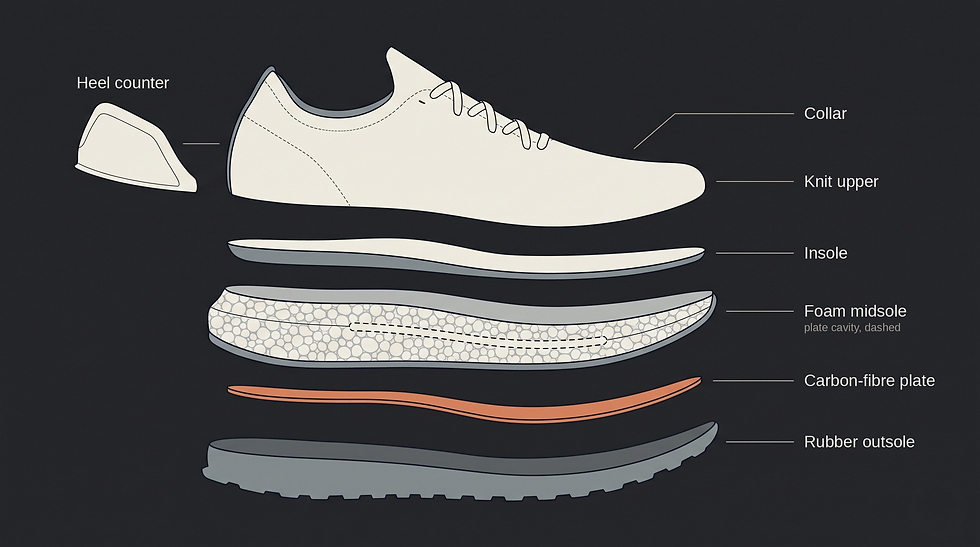
These components are coupled. Increasing midsole thickness generally lowers torsional and bending stiffness unless a plate is added; adding a plate changes the effective lever arm at the forefoot; changing last width alters how the foot loads the midsole; and stiffening the heel counter changes the demand placed on the collar. Evaluating any single feature in isolation, which is how footwear is usually marketed and discussed, produces conclusions that do not hold for the assembled product.
Sport-specific Footwear Design
Sport-specific footwear reflects genuine differences in mechanical demand rather than market segmentation alone. Each design represents a different solution to a different mechanical problem, and the differences are largest in the components that interact with the surface. The four cases considered below do not represent an exhaustive overview; they are chosen because they illustrate four distinct problems, namely traction on a deformable surface, landing and cutting on a rigid high-friction surface, force application within a very short contact on a synthetic track, and controlled sliding on a surface-dependent interface. The same reasoning extends to categories not treated here, including footwear for strength training and for running on irregular terrain.

Football boots are optimised for traction on deformable surfaces. The studded outsole is designed to penetrate turf and generate translational and rotational resistance during acceleration, deceleration and change of direction. The design problem is that the traction which improves propulsion also produces the rotational torque that loads the knee and ankle when the foot is fixed. The systematic review by Yang and colleagues (2026) synthesised thirty-two studies on boot design and lower limb injury and described this relationship: screw-in and bladed stud configurations generate high rotational torque on both natural and artificial turf, contributing to foot fixation, while sole plate stiffness appears to have a U-shaped relationship with injury risk, with excessive rigidity restricting first ray dorsiflexion and excessive compliance increasing ankle inversion and knee valgus angles. Traction in football is therefore not a variable to be maximised, but one to be matched to the surface and to the player.
Basketball shoes address a different combination of demands: repeated high-magnitude landings, rapid multidirectional cutting, and a hard, high-friction indoor surface. The design emphasis falls on impact attenuation, frontal plane ankle stability and forefoot stiffness for push-off. The systematic review by Lam and colleagues (2022) found that softer midsoles improve impact attenuation in unanticipated landings, that higher collars improve ankle stability during jumping and cutting, that increased traction and forefoot bending stiffness improve jump, sprint and cut performance, and that lighter shoes produce better jump and cut performance when the athlete is aware of the mass. These effects do not all point in the same direction, which is why basketball footwear involves a particularly explicit set of compromises.
Sprint spikes follow a different design logic. Mass is minimised, the midsole is thin under the forefoot, the plate is markedly stiff, and the pin geometry is designed for near-instantaneous mechanical interlock on a synthetic track. The objective is to minimise energy dissipation at the metatarsophalangeal joint during very short contact times and to keep the centre of pressure forward. Cushioning is largely sacrificed, which is reasonable in an event lasting ten seconds and considerably less so in training sessions that accumulate thousands of contacts.
Tennis shoes must accommodate surface-dependent sliding. Damm and colleagues (2013) showed that players adapt the utilised coefficient of friction to the surface, sliding on clay with a less flexed knee at impact and braking on hard court with greater knee flexion. The shoe on clay is designed to permit controlled sliding through a herringbone tread and a relatively low-friction compound, while the hard court shoe emphasises durability, lateral support and abrasion resistance. When a player moves between surfaces in footwear designed for the other, load that the shoe-surface interface would otherwise manage is transferred to the knee and the ankle.
Midsole Materials and Energy Return
The midsole is where most of the mechanical energy exchange occurs, and midsole behaviour is governed by three properties: stiffness, which determines how much the material deforms under a given load; resilience, which describes the proportion of stored energy returned rather than dissipated as heat; and the rate-dependence of both, since foams behave differently at the loading rates of walking, running and jumping.
Traditional midsoles use ethylene-vinyl acetate, a foam that is inexpensive, durable and comparatively lossy, typically returning in the region of sixty to seventy per cent of the energy stored in compression. Thermoplastic polyurethane and expanded TPU improved on this, and the current generation of high-performance midsoles uses polyether block amide, often processed with supercritical fluid foaming to produce a material that is simultaneously lighter, more compliant and considerably more resilient. The mechanical consequence is that a thicker midsole no longer necessarily costs energy. Historically, added stack height meant added mass and added hysteretic loss; with contemporary foams, the additional deformation is largely recovered.
This shift positions the midsole as a performance component rather than only a protective one. Askew and colleagues (2026) quantified the material properties of an advanced footwear technology shoe against a lightweight control and found that the advanced shoe stored more energy under compression, though with lower resilience, and was approximately four times stiffer in bending. In the same study the running economy benefit declined exponentially with gradient, from 4.22 per cent on the level to 0.52 per cent at a nine per cent incline, which is informative about mechanism. If the advantage were primarily due to mass or geometry it would persist uphill; the fact that it does not suggests that the benefit depends on elastic energy storage and return, and that this mechanism contributes progressively less as the proportion of positive work required increases.
Stack height itself continues to matter. Baumann and colleagues (2025) compared advanced footwear at 40 mm, the current World Athletics limit for road competition, with a 50 mm version and an entry-level shoe, and found that running economy improved by 2.4 per cent with the 40 mm shoe relative to the entry-level model and improved by a further 0.6 per cent with the 50 mm version. The 40 mm shoe was perceived as more comfortable than the 50 mm shoe, which indicates that the metabolic optimum and the perceptual optimum are not necessarily the same point.
Outsole material operates on a different axis. Rubber compound hardness, tread geometry and contact area determine the available coefficient of friction, which governs how much horizontal force an athlete can express during acceleration and deceleration. In court and field sports the outsole is frequently the component with the largest effect on performance, and the one most sensitive to surface, moisture and wear.
Bending Stiffness and the Metatarsophalangeal Joint
The metatarsophalangeal joint is a net dissipator of mechanical energy during running and jumping. It absorbs a substantial quantity of energy during late stance and returns very little of it, and this observation motivated one of the more productive lines of footwear research of the past twenty-five years. Stefanyshyn and Nigg (2000) inserted carbon fibre plates into shoe midsoles and showed that increasing bending stiffness reduced the energy lost at the metatarsophalangeal joint and increased vertical jump height by an average of 1.7 cm. Roy and Stefanyshyn (2006) subsequently reported an approximately one per cent improvement in running economy with stiffer midsoles, although the expected reduction in metatarsophalangeal energy absorption was not observed, which left the mechanism unresolved.
The subsequent literature has clarified the shape of the relationship without fully resolving the mechanism. The meta-analysis by Rodrigo-Carranza and colleagues (2022), which included twelve studies, found that increased longitudinal bending stiffness improved running economy with a standardised mean difference of -0.43, with larger benefits at higher running speeds, with curved plates producing a 3.45 per cent improvement while flat plates produced none, and with the improvement accompanied by increased stride length and increased ground contact time. The finding regarding plate curvature is informative, because it indicates that the effect is not attributable to stiffness alone but to the interaction of stiffness with geometry, specifically with the rocker profile that a curved plate imposes on the shoe.
The relationship is also non-monotonic. Rodrigo-Carranza and colleagues (2024) compared two levels of plate stiffness within an advanced footwear midsole and found that the moderately stiff configuration at 35.5 N/mm improved running economy by 2.56 per cent relative to control, while the stiffest configuration at 43.1 N/mm did not differ significantly from control. There appears to be an optimum beyond which additional stiffness is counterproductive, and the location of that optimum is likely to depend on the athlete's mass, plantar flexor strength and running speed.
Plate position within the construction matters as well. Flores and colleagues (2021) compared a stiff plate placed high in the shoe, directly under the insole, with the same plate placed low between midsole and outsole, and reported that the high position increased metatarsophalangeal dorsiflexion and ankle plantar flexion, improved the alignment between the resultant ground reaction force and the leg, and reduced lower limb joint torques. Two shoes with identical bending stiffness can therefore produce different joint kinetics depending on where the stiffening element sits.
A particularly informative result comes from Healey and Hoogkamer (2022), who cut through the carbon plate of a Nike Vaporfly 4% in six places to reduce its bending stiffness, and found no significant change in running economy. The plate's stiffening effect on the metatarsophalangeal joint appears to play a limited role in the energy saving attributed to these shoes, which suggests that the benefit arises from the combination and interaction of foam, geometry and plate rather than from the plate as an independent element.
Sprinting and Change of Direction
Much of the evidence discussed so far derives from distance running research, and those conditions differ substantially from those of sprinting and cutting. Ground contact time at maximal velocity is in the region of 80 to 110 ms, against roughly 200 to 250 ms in submaximal endurance running, and the ground reaction forces are considerably larger. When the time available for deformation and recovery is halved, the behaviour of a compliant midsole changes: a foam that returns energy usefully over 220 ms may not complete its compression and recovery cycle within 90 ms, and the phase relationship between material deformation and the athlete's force application becomes the limiting consideration rather than resilience alone. This is one reason sprint footwear has evolved towards thin, firm forefoot construction with a rigid plate, while endurance footwear has moved in the opposite direction.

The evidence on plate stiffness at high velocity is less consistent than the endurance literature might suggest. The meta-analysis by Rodrigo-Carranza and colleagues (2022) reported that the running economy benefit of increased longitudinal bending stiffness was larger at higher running speeds, which was widely read as an argument for stiffer plates in sprinting. Mackala and colleagues (2025), however, compared classic spikes with carbon-plated spikes across repeated 50 m sprints in twelve well-trained junior sprinters and found no significant differences in kinematic parameters, concluding that sole bending stiffness may not influence performance over distances up to approximately 50 to 60 m. Read together with the super-spike findings over 800 m and 3000 m (Rodrigo-Carranza et al., 2025), a coherent picture emerges in which plate and foam technology appears to benefit events where metabolic economy is a limiting factor, while contributing little where the constraint is the rate of force development within an extremely short contact.
Acceleration and maximal velocity also impose different demands on the same shoe. During the initial steps the ground reaction force is oriented substantially forwards, the ankle operates through a larger range, and available translational traction determines how much horizontal force can be expressed. At maximal velocity the orientation becomes more vertical, contact time shortens considerably, and the priority shifts towards minimising energy dissipation at the metatarsophalangeal joint and maintaining the position of the centre of pressure. A single spike geometry is a compromise between these two phases, which is why sprinters over different distances tend to prefer different plate stiffnesses and pin configurations.
Change of direction introduces a third and largely separate problem, because it requires resistance to translation while permitting rotation. These two requirements are met by different features of the shoe, and they are frequently in conflict. High translational traction improves braking and reorientation, while high rotational traction resists the rotation of the shoe relative to the surface and transmits the residual torque to the ankle and knee. The systematic review by Yang and colleagues (2026) identified this as the principal mechanism by which boot design influences non-contact injury, describing a foot-lock phenomenon with screw-in and bladed studs on both natural and artificial turf. Lam and colleagues (2022) similarly found that increased traction and forefoot bending stiffness improved cutting and sprint performance in basketball, which places performance and joint loading on the same axis rather than on opposing ones. The design objective in these sports is therefore an asymmetry between translational and rotational traction, not a maximum of either, and the appropriate point on that continuum depends on the surface, its moisture content, the athlete's mass and the sport's movement profile.
Drop, Stack Height, Toe Box and Collar
Heel-to-toe drop is the footwear parameter most frequently discussed, and one of the most frequently misinterpreted. Drop influences ankle dorsiflexion at initial contact, foot strike pattern and the distribution of load between the posterior chain and the anterior structures of the shank. The best available evidence on its relationship with injury comes from the randomised controlled trial by Malisoux and colleagues (2016), in which 553 leisure-time runners received shoes with 10 mm, 6 mm or 0 mm drop and were followed for six months. Overall injury risk did not differ between conditions. When the sample was stratified by prior running regularity, however, lower drop shoes were associated with reduced injury risk in occasional runners and with increased injury risk in regular runners. The value of this result lies in the contrast between the null main effect and the significant interaction. Drop does not carry an intrinsic risk profile; it interacts with the athlete's history and accumulated tissue adaptation.
Stack height determines the vertical distance between the foot and the ground and therefore the length of the moment arm through which frontal plane ground reaction forces act on the ankle. Higher stacks increase this lever and, other things being equal, increase the demand placed on the evertor and invertor musculature and on the passive lateral structures. This is a plausible mechanism for the frequently reported perception of instability in maximal stack footwear, and a reason for caution when such shoes are used in training that includes changes of direction.
The toe box and the forefoot geometry of the last determine whether the foot can spread under load. During weight acceptance the forefoot widens, the transverse arch flattens and the hallux abducts. A last that constrains this behaviour transfers load medially, restricts the function of the plantar intrinsic musculature, and limits the hallux dorsiflexion required for effective propulsion. Evidence linking toe box geometry to specific pathologies remains mixed; Bajraszewski and colleagues (2025) found no association between toe box differential and medial forefoot pressures in older women with hallux valgus. The relevant conclusion is that fit should be evaluated functionally, under load and in sport-specific positions, rather than statically or by shoe size.
Heel counter stiffness and collar height act together on rearfoot and ankle motion. Lam and colleagues (2020) examined both in basketball players during drop landings and found that high collar shoes reduced peak ankle dorsiflexion and total sagittal range of motion but increased peak knee varus moment, while stiffer heel counters reduced ankle inversion at touchdown and coronal plane range of motion but increased peak knee flexion and increased forefoot ground reaction force peaks when combined with a high collar. Constraining motion at the ankle does not remove that motion from the system; it relocates it proximally. This principle recurs throughout footwear biomechanics and appears to be under-recognised in practice.
Super-shoes and the Limits of the Evidence
Advanced footwear technology has produced one of the clearest performance effects documented for an equipment change in endurance sport, and the magnitude of that effect is now reasonably well characterised. The combination of a thick, compliant, high-resilience midsole with an embedded curved plate improves running economy by approximately three to four per cent relative to traditional racing footwear on level ground, and the effect extends beyond road running. Rodrigo-Carranza and colleagues (2025) tested track spikes incorporating PEBA foam with and without a carbon plate against a traditional spike in trained runners and found that 800 m race-pace performance improved by around two per cent in both experimental conditions, that 3000 m time trial performance improved by 1.0 per cent with PEBA alone and 2.4 per cent with PEBA and a plate, and that running economy improved by 5.1 per cent and 4.0 per cent respectively.
Several qualifications are important. The effect is context-dependent: as Askew and colleagues (2026) demonstrated, it declines exponentially with gradient and becomes negligible above moderate inclines, which has direct implications for trail and undulating courses. The effect is also individual, with substantial between-subject variability in the magnitude of the economy benefit. Connick and Lichtwark (2025) proposed a theoretical framework distinguishing a direct effect of footwear properties, such as energy return, from a mediating effect operating through changes in ankle and foot biomechanics and in the behaviour of the spring-mass system. Under that framework, the same shoe produces different outcomes in different athletes because the mediating pathway depends on individual tendon properties, plantar flexor strength and running mechanics. This is a useful conceptual model, and it supports individualised footwear selection rather than universal adoption.
There is a further consideration that receives less attention. Because these shoes reduce the metabolic cost of a given speed, they allow athletes to accumulate more high-speed work for the same perceived and physiological effort. The training stimulus is thereby altered, not only the race performance. Whether the mechanical loading experienced by bone and tendon is reduced in proportion to the reduction in metabolic cost is not established, and there are reasons to think it may not be.
Footwear and the Redistribution of Load
The relationship between footwear and injury is an area in which several long-standing assumptions have been challenged. Two well-conducted randomised controlled trials illustrate the point. Theisen and colleagues (2014) followed 247 leisure-time runners in shoes differing in midsole hardness for five months and found no association between midsole hardness and running-related injury, while body mass index, previous injury and mean session intensity were all associated with risk. Malisoux and colleagues (2016), as described above, found no main effect of heel drop on injury risk. Systematic review evidence on running economy similarly indicates only small effects for most footwear characteristics, with shoe mass showing the most consistent relationship with metabolic cost (Fuller et al., 2015).
A reasonable interpretation is that footwear does not reduce total load so much as redistribute it. This pattern is visible throughout the literature. Constraining ankle motion with a high collar increases knee varus moment (Lam et al., 2020). Increasing sole plate rigidity in football boots restricts first ray dorsiflexion and concentrates plantar pressure (Yang et al., 2026). Reducing the mechanical work performed by the plantar intrinsic musculature through supportive footwear appears to reduce the size and strength of those muscles, and the converse also holds: Ridge and colleagues (2019) found that eight weeks of walking in minimalist footwear increased foot muscle size and strength as effectively as a dedicated foot strengthening programme.

The most recent evidence on advanced footwear illustrates this redistribution. Bruneau and colleagues (2026) measured biomechanical variables associated with bone stress injury in twenty-three elite distance runners across neutral, responsive foam and advanced footwear conditions at three speeds. Ankle plantar flexion moment was lower in the advanced footwear than in the neutral shoe, which is consistent with reduced demand on the plantar flexors. At the same time, rearfoot eversion excursion was greater and cadence was lower in the advanced footwear. The individual changes were small, but their direction is consistent with increased loading of medial midfoot structures, and they occur in athletes who accumulate very high running volumes. The authors' conclusion, that cumulative effects could contribute to injury and should be considered when using this footwear in training and competition, is appropriately measured and, in my view, correct.
Traction follows the same logic in different tissues. High rotational traction improves the ability to generate horizontal force and simultaneously increases the torque transmitted to the knee when the foot cannot rotate. The optimum is not a maximum, and it depends on the surface, the sport, the position and the athlete.
Footwear Within the Athlete's System
The systems perspective changes what questions are worth asking about footwear. The relevant question is not which shoe is best, since that question has no general answer, but how a given shoe interacts with a given athlete's structure, movement strategy, training content and competition surface.
Several practical implications follow. Footwear should be documented as a training variable. If a coach records session load, surface and volume but not footwear, then a change of shoe becomes an unmeasured confounder in every subsequent interpretation of the data. Recording model, stack, drop and approximate accumulated mileage costs almost nothing and prevents a recurring source of error.
Footwear changes should be treated as changes in training stimulus, and introduced with the same progression logic applied to any other stimulus. A change from a 10 mm drop to a 4 mm drop alters the length-tension operating range of the plantar flexors and the loading of the Achilles tendon; a shift into a high-stack plated shoe alters foot and midfoot loading. These represent adaptive demands, and adaptation requires time. The interaction observed by Malisoux and colleagues (2016), in which low-drop shoes were protective for occasional runners and hazardous for regular runners, is best explained in exactly these terms.
Footwear should also be differentiated by purpose within the athlete's rotation. The demands of easy aerobic volume, high-intensity interval work, gym-based strength training and competition are mechanically distinct, and a single shoe is unlikely to be optimal across all of them. A rotation additionally varies the loading pattern, which is desirable in itself, since repetitive identical loading is a plausible contributor to overuse pathology.
Finally, comfort may be treated as data rather than dismissed as subjective. The comfort filter proposed by Nigg and colleagues (2015) is a reasonable working hypothesis: an athlete's perception of comfort integrates a large number of mechanical variables that are difficult to measure individually, and it appears to correlate with remaining within the individual's preferred movement path. Comfort is not sufficient on its own, and it can mislead when an athlete is habituated to inappropriate footwear, but as one input among several it carries genuine information.
Conclusion
Footwear occupies an unusual position in performance science. It has a measurable and in some cases substantial effect on the energetics and mechanics of movement, and it is at the same time among the variables least likely to appear in an athlete's monitoring system. The evidence reviewed here indicates that midsole material and geometry can alter the energetic cost of running by several per cent, that bending stiffness and plate curvature change joint kinetics in ways that depend on where the stiffening element sits, that traction determines both the horizontal force an athlete can express and the torque transmitted to the knee, and that constraining motion at one joint tends to increase demand at another.
None of these findings supports the idea of an optimal shoe. They support a more useful conclusion, which is that footwear is one component of a coupled system that includes the athlete's anatomy, the surface, the movement demands of the sport and the accumulated adaptation of the tissues involved. Changing one component changes the behaviour of the whole, which may explain why the same shoe benefits one athlete and contributes to injury in another, and why group means in footwear research often conceal the individual effect.
The practical change required is modest in effort and meaningful in consequence. Footwear can be measured, recorded, progressed and individualised in the same way as any other training variable. Until it is, the interface through which every unit of force passes will remain one of the least understood elements of an otherwise carefully controlled system.
---
Frequently Asked Questions
Q: Should athletes in team sports rotate between different shoe models during a season?
Rotation is defensible on mechanical grounds. Different models distribute plantar pressure and joint loading differently, and varying the pattern reduces the repetitive identical loading associated with overuse pathology. The practical constraint is that traction characteristics should remain appropriate to the surface, so rotation is most sensible between models with comparable outsole behaviour but differing midsole and upper construction. Rotation should also be planned rather than improvised, since introducing an unfamiliar shoe during a congested competition period adds an unnecessary variable.
Q: How long should the transition to a substantially different shoe take?
There is no established protocol, but the relevant consideration is which tissues face increased demand. A reduction in heel drop increases loading of the Achilles tendon and plantar flexors, and tendon adapts over months rather than weeks. A reasonable approach is to introduce the new footwear for a small proportion of low-intensity volume, perhaps ten to twenty per cent, and to increase gradually over six to twelve weeks while monitoring local symptoms. Transitions should not coincide with increases in training volume or intensity.
Q: Do super-shoes benefit all runners equally?
No. The average improvement in running economy is approximately three to four per cent on level ground, but between-subject variability is substantial and some individuals gain very little. The framework proposed by Connick and Lichtwark (2025) attributes this to a mediating pathway through individual foot and ankle biomechanics, meaning that the response depends on tendon properties, plantar flexor strength and running mechanics. The benefit also declines markedly with gradient, so the advantage on a hilly course is considerably smaller than on a flat one, and it does not appear to transfer to short sprinting: Mackala and colleagues (2025) found no kinematic differences between classic and carbon-plated spikes over 50 m.
Q: Is higher traction always better in football and other field sports?
No. Traction improves the ability to generate horizontal force during acceleration and change of direction, but the same traction transmits rotational torque to the ankle and knee when the foot becomes fixed. The systematic review by Yang and colleagues (2026) associated screw-in and bladed stud configurations with elevated rotational torque and foot fixation on both natural and artificial turf. Stud selection should be matched to surface condition, and the objective is sufficient traction rather than maximum traction.
Q: What should a practitioner record about footwear if resources are limited?
At minimum: model and version, stack height and drop if published, the training contexts in which each shoe is used, and the approximate accumulated distance or hours on each pair. This information takes a few minutes per athlete per month and prevents footwear from acting as an unmeasured confounder when movement data, load metrics or symptoms change. Where possible, adding a periodic comfort rating for each shoe provides a low-cost indicator that integrates several mechanical variables.
References
Askew, G.N., Hill, S., Payne, M., Stewart, T.D., Charles, D. and Brown, A.P. (2026) 'Running economy benefits of shoes incorporating advanced footwear technology decrease with increasing incline and are negligible above moderate gradients', Scandinavian Journal of Medicine & Science in Sports, 36(5), e70298.
Bajraszewski, K.J., Lim, P.Q.X., Buldt, A.K., Hurn, S.E., Mickle, K.J., Roddy, E., Wluka, A.E., Erbas, B., Munteanu, S.E. and Menz, H.B. (2025) 'Footwear toe-box shape and medial forefoot pressures in women with hallux valgus', Journal of Foot and Ankle Research, 18(2), e70041.
Baumann, G.-A., Biedermann, K., Item, E., Spengler, C.M. and Beltrami, F.G. (2025) 'The effect of midsole thickness on running economy, spatiotemporal values and perceptions of comfort and exertion in well-trained runners: a randomized, cross-over trial', Sports Medicine – Open, 11(1), 108.
Bruneau, M.M., Gaudette, L.W., Sirls, E., Hollander, K., Saxena, A., Hoenig, T., De Carlo, F., Fodera, A., Sullivan, V., Bean, A., Lussner, A., Baxter, Z. and Tenforde, A.S. (2026) 'Biomechanics associated with bone stress injuries while using advanced footwear technology in elite distance runners', PM&R, 18(Suppl. 2), pp. S143–S150.
Connick, M.J. and Lichtwark, G.A. (2025) 'Individualization of footwear for optimizing running economy: a theoretical framework', Journal of Applied Biomechanics, 41(1), pp. 1–7.
Damm, L., Low, D., Richardson, A., Clarke, J., Carré, M. and Dixon, S. (2013) 'The effects of surface traction characteristics on frictional demand and kinematics in tennis', Sports Biomechanics, 12(4), pp. 389–402.
Flores, N., Rao, G., Berton, E. and Delattre, N. (2021) 'The stiff plate location into the shoe influences the running biomechanics', Sports Biomechanics, 20(7), pp. 815–830.
Fuller, J.T., Bellenger, C.R., Thewlis, D., Tsiros, M.D. and Buckley, J.D. (2015) 'The effect of footwear on running performance and running economy in distance runners', Sports Medicine, 45(3), pp. 411–422.
Healey, L.A. and Hoogkamer, W. (2022) 'Longitudinal bending stiffness does not affect running economy in Nike Vaporfly shoes', Journal of Sport and Health Science, 11(3), pp. 285–292.
Lam, W.K., Cheung, C.C.W. and Leung, A.K.L. (2020) 'Shoe collar height and heel counter-stiffness for shoe cushioning and joint stability in landing', Journal of Sports Sciences, 38(20), pp. 2374–2381.
Lam, W.K., Kan, W.H., Chia, J.S. and Kong, P.W. (2022) 'Effect of shoe modifications on biomechanical changes in basketball: a systematic review', Sports Biomechanics, 21(5), pp. 577–603.
Mackala, K., Krzysztofik, M., Weber, A., Mroczek, D. and Zajac, A. (2025) 'Profile of 50 m sprinting: the influence of carbon-plated spikes on maximum-velocity performance', Sensors, 25(7), 1979.
Malisoux, L., Chambon, N., Urhausen, A. and Theisen, D. (2016) 'Influence of the heel-to-toe drop of standard cushioned running shoes on injury risk in leisure-time runners: a randomized controlled trial with 6-month follow-up', American Journal of Sports Medicine, 44(11), pp. 2933–2940.
Nigg, B.M., Baltich, J., Hoerzer, S. and Enders, H. (2015) 'Running shoes and running injuries: mythbusting and a proposal for two new paradigms: "preferred movement path" and "comfort filter"', British Journal of Sports Medicine, 49(20), pp. 1290–1294.
Ridge, S.T., Olsen, M.T., Bruening, D.A., Jurgensmeier, K., Griffin, D., Davis, I.S. and Johnson, A.W. (2019) 'Walking in minimalist shoes is effective for strengthening foot muscles', Medicine & Science in Sports & Exercise, 51(1), pp. 104–113.
Rodrigo-Carranza, V., González-Mohíno, F., Santos-Concejero, J. and González-Ravé, J.M. (2022) 'The effects of footwear midsole longitudinal bending stiffness on running economy and ground contact biomechanics: a systematic review and meta-analysis', European Journal of Sport Science, 22(10), pp. 1508–1521.
Rodrigo-Carranza, V., Hoogkamer, W., González-Ravé, J.M. and González-Mohíno, F. (2024) 'Relationship between advanced footwear technology longitudinal bending stiffness and energy cost of running', Scandinavian Journal of Medicine & Science in Sports, 34(6), e14687.
Rodrigo-Carranza, V., Muñoz de la Cruz, V. and Hoogkamer, W. (2025) 'Influence of advanced-footwear-technology spikes on middle- and long-distance running performance measures in trained runners', International Journal of Sports Physiology and Performance, 20(5), pp. 689–699.
Roy, J.-P.R. and Stefanyshyn, D.J. (2006) 'Shoe midsole longitudinal bending stiffness and running economy, joint energy, and EMG', Medicine & Science in Sports & Exercise, 38(3), pp. 562–569.
Stefanyshyn, D.J. and Nigg, B.M. (2000) 'Influence of midsole bending stiffness on joint energy and jump height performance', Medicine & Science in Sports & Exercise, 32(2), pp. 471–476.
Theisen, D., Malisoux, L., Genin, J., Delattre, N., Seil, R. and Urhausen, A. (2014) 'Influence of midsole hardness of standard cushioned shoes on running-related injury risk', British Journal of Sports Medicine, 48(5), pp. 371–376.
Yang, F., Huang, J., Wei, Q., Jiang, L. and Liang, D. (2026) 'The impact of football boot design on lower limb injury risk: a systematic review', Sports Medicine – Open, 12(1).

Antonio Robustelli is the founder of Omniathlete. He is an international high performance consultant and sought-after speaker in the area of Sport Science and Sports Medicine, working all over the world with individual athletes (including participation in the last 5 Olympics) as well as professional teams in soccer, basketball, rugby, baseball since 24 years. Currently serving as Faculty Member and Programme Leader at the National Institute of Sports in India (SAI-NSNIS).


Comments