


Heart Rate Variability in Sport: From Early Adoption to a Modern Understanding of Regulation

Updated: Aug 8
I started using heart rate variability in sport long before it became fashionable. Back in 2009, there were no smartphone apps, no fingertip sensors, no cloud dashboards. If you wanted HRV, you had to build the workflow yourself: biofeedback amplifiers, ECG or BVP (Blood Volume Pulse) sensors, raw RR intervals, and Kubios to make sense of the signal. It was slow and technical, but that was precisely the value. You couldn’t hide behind a colour‑coded score or a “readiness” label. You had to understand what you were measuring, why it mattered, and what it didn’t tell you.
That early experience shaped how I still interpret HRV today. It taught me that HRV is not a magical window into the entire autonomic nervous system, nor a universal indicator of stress or fatigue. It is a specific cardiac signal, reflecting how the heart is being regulated at a given moment. And if we want HRV to remain a meaningful tool in sport, we need to move beyond outdated concepts and adopt a more accurate, nuanced understanding of what the signal actually represents.
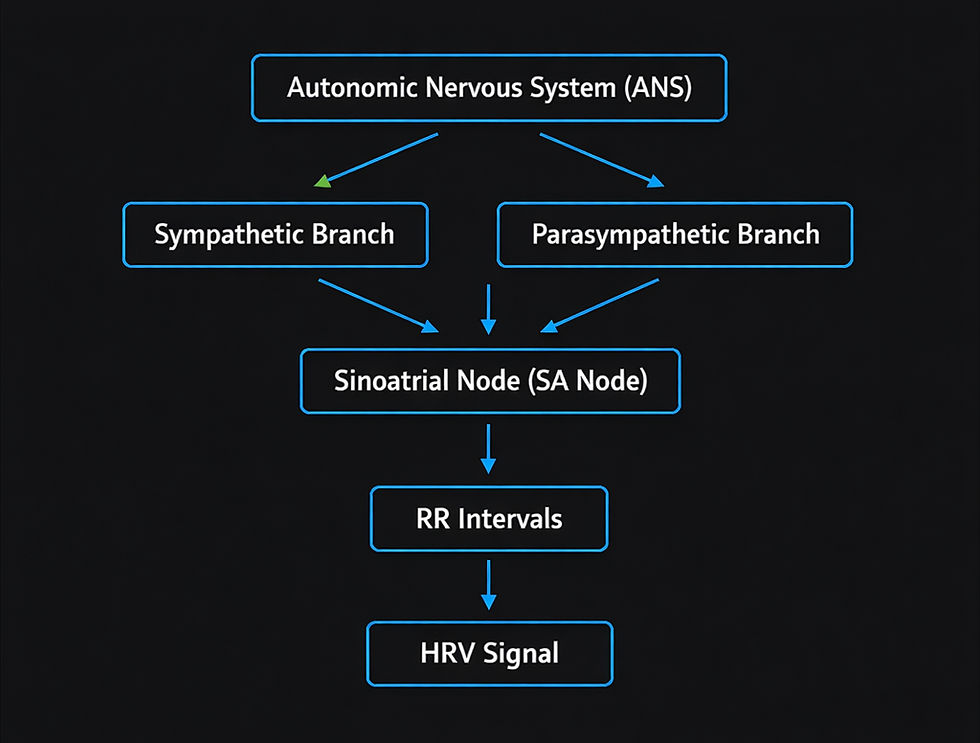
HRV Measures Cardiac Autonomic Regulation — Not the Whole Autonomic Nervous System
One of the most persistent misconceptions in sport is the idea that HRV measures “the autonomic nervous system.” It doesn’t. HRV measures how the autonomic nervous system modulates the sinoatrial node — and that is a very specific output channel. The ANS is not a monolithic system that rises and falls uniformly across all organs. Different branches and target tissues respond independently, depending on context, task demands, and internal state.
This is why HRV cannot tell you how the central nervous system is functioning, whether neuromuscular fatigue is present, what your hormonal or metabolic status is, how your immune system is responding, or whether your tissues are recovered. What it tells you is how the heart is being regulated — nothing more, nothing less. And that specificity is exactly why HRV is useful, as long as we interpret it correctly.
The Sympathetic/Parasympathetic “Balance” Model Is Outdated
For years, HRV was framed as a tug‑of‑war between sympathetic and parasympathetic activity. LF was labelled “sympathetic”, HF was labelled “parasympathetic”, and the LF/HF ratio was sold as a measure of “autonomic balance”. This model is still repeated today, particularly on commercial platforms, but it simply doesn't hold up to scrutiny.
The reality is considerably more complex. LF is not a pure sympathetic marker. HF is vagal, but heavily influenced by breathing rate and tidal volume. LF/HF is not a physiologically valid measure of autonomic balance — breathing patterns alone can shift vagal oscillations into the LF band, and baroreflex activity plays a major role in shaping spectral components. During exercise, spectral indices behave unpredictably and lose much of their interpretability. In athletes, where breathing patterns, metabolic demands, and regulatory strategies vary widely, the "balance" model becomes even less meaningful. The body is not trying to balance two branches; it is trying to regulate efficiently.
HRV Is About Regulation, Not Balance
Athletes are not sedentary clinical patients. Their physiology is shaped by years of training, high workloads, and complex adaptive processes. In this population, regulatory intelligence — the ability to coordinate multiple systems efficiently — is far more important than the absolute level of sympathetic or parasympathetic activity.
This is why HRV in athletes must be interpreted through the lens of regulation rather than balance.
Years of applied work have reinforced this perspective in several ways. Endurance athletes often show high RMSSD and HF, but this is not simply "more parasympathetic tone" — structural and intrinsic adaptations of the sinus node play a major role. Overtraining does not produce a single autonomic pattern: some athletes show sympathetic dominance, others parasympathetic dominance, and many show mixed or unstable patterns. Fatigue often increases the variability of HRV patterns rather than producing a consistent directional shift. Static and dynamic exercise at the same heart rate produce different HRV signatures, demonstrating that HRV reflects regulatory strategies, not autonomic "levels." And breathing entrainment can dramatically alter spectral components without any meaningful change in physiological stress.
The common thread running through all of this is straightforward: HRV reflects how the cardiovascular system is being regulated, not which branch of the ANS is "winning".
Time‑Domain vs Frequency‑Domain: Different Tools for Different Questions
My early work with Kubios forced me to understand the difference between time-domain and frequency-domain metrics, and that distinction remains essential today.

Time-domain measures — RMSSD, SDNN, pNN50 — are the most practical tools for applied monitoring. RMSSD is the most stable short-term metric, reflecting beat-to-beat vagal modulation with relatively little sensitivity to breathing rate. Ultra-short RMSSD windows of 60 to 90 seconds are both reliable and practical, making it the ideal choice for daily athlete monitoring.
Frequency-domain measures — LF, HF, LF/HF — offer a different kind of information. They provide insight into the oscillatory patterns of autonomic regulation, but they are highly sensitive to breathing, posture, and signal non-stationarity. This makes them genuinely useful in controlled laboratory settings or structured protocols, but far less reliable for daily field monitoring. LF/HF, as already discussed, should not be interpreted as a measure of autonomic balance under any circumstances.
The practical takeaway is simple: use RMSSD for daily monitoring, reserve spectral analysis for controlled conditions, and resist the temptation to read sympathetic or parasympathetic dominance into a ratio.
HRV During Exercise: A Non‑Stationary Signal with Limited Meaning
During exercise, HRV decreases as heart rate increases, driven primarily by parasympathetic withdrawal. But what happens to the spectral components is considerably messier. HF collapses as breathing rate rises. LF may rise, fall, or remain unchanged depending on intensity and methodology. Non-stationarity violates the mathematical assumptions that underlie spectral analysis. And humoral factors such as catecholamines influence HRV independently of neural activity. The result is that HRV during exercise is not a reliable measure of autonomic state in any meaningful sense.
Post-exercise HRV recovery, however, is a different story. Faster RMSSD recovery indicates better fitness and regulatory efficiency. High-intensity intervals delay vagal reactivation. Aerobically fit athletes recover HRV more quickly. In practice, what happens to HRV after training often tells you far more than anything that happens during it.
HRV and Fatigue: Patterns Matter More Than Numbers
Fatigue in athletes is not a single, uniform state — and HRV reflects this complexity faithfully. Some athletes show reduced HRV under fatigue. Others show elevated HRV. Many show unstable or scattered patterns, delayed recovery after training, or paradoxical increases in vagal markers during functional overreaching. There is no single signature.

This is precisely why the logic of "high HRV equals good, low HRV equals bad" breaks down so quickly in practice. Trends matter more than absolute values. Context determines interpretation. A single number, however precisely measured, cannot replace a longitudinal perspective on an individual athlete's regulatory behaviour. This is how I've always used HRV — not as a readiness score, but as a regulatory signal embedded in a broader monitoring context.
Heart Rate Variability Must Be Integrated, Not Isolated
HRV alone cannot capture the complexity of athlete readiness. It says nothing about:
CNS fatigue
neuromuscular status
metabolic readiness
hormonal state
tissue recovery
biomechanical load
This is not a limitation unique to HRV — no single marker covers all of this — but it is a point worth stating clearly, because the commercial narrative around HRV has often implied otherwise.
Used intelligently, HRV is one piece of a larger puzzle. It becomes far more meaningful when integrated alongside subjective markers, neuromuscular tests, performance diagnostics, sleep data, and contextual information such as travel, illness, and training load. The signal does not become more powerful by standing alone. It becomes more powerful when it is one well-understood component of a coherent monitoring strategy.
Practical Guidelines for Using HRV in Sport Today
Based on years of applied work, these principles summarize a modern, scientifically grounded approach:
Use RMSSD as the primary daily metric
Avoid interpreting LF/HF as autonomic balance
Use spectral analysis only in controlled conditions
Focus on trends, not single values
Integrate HRV with other physiological and performance markers
Interpret HRV through the lens of regulation, not stress
Remember that HRV is cardiac‑specific
Conclusion: HRV as a Window into Regulatory Intelligence
More than fifteen years after those early days of amplifiers and raw data analysis and interpretation, HRV remains one of the most valuable tools in applied sport science — but only when used correctly. It is not a measure of stress. It is not a measure of the entire autonomic nervous system. It is not a measure of sympathetic/parasympathetic balance.
It is a precise cardiac signal that reveals how the athlete is regulating cardiovascular function in response to internal and external demands. When integrated with other markers, it becomes a powerful component of a multi-system monitoring strategy — one that respects the complexity of human adaptation and the individuality of each athlete.
Used this way, HRV doesn't simplify the athlete. It helps us understand them.
---
Frequently Asked Questions
Q: Does HRV measure the autonomic nervous system?
Not in its entirety. HRV measures how the autonomic nervous system
modulates the sinoatrial node — a specific and narrow output channel,
not a global readout of autonomic function. The ANS regulates multiple
organs and tissues simultaneously, and these respond independently
depending on context, task demands, and internal state. HRV tells you
how the heart is being regulated at a given moment. It says nothing about
CNS fatigue, neuromuscular status, hormonal state, immune activity, or
tissue recovery. That specificity is precisely what makes HRV useful —
but only when we avoid overstating what it actually captures.
Q: Is the LF/HF ratio a valid measure of sympathetic and parasympathetic balance?
No. The sympathetic/parasympathetic "balance" framework is
physiologically outdated and should not be used to interpret
HRV data in athletes. LF power is not a pure sympathetic marker —
it reflects a mix of sympathetic activity, vagal modulation, and
baroreflex dynamics. HF power is vagally driven but heavily
influenced by breathing rate and tidal volume. The LF/HF ratio is
not a validated index of autonomic balance under any recording
conditions. In athletes, where breathing patterns, metabolic demands,
and regulatory strategies vary considerably, the entire framework
becomes even less meaningful. Breathing entrainment alone can
shift vagal oscillations into the LF band without any change in
physiological stress, producing ratio changes that reflect respiratory
mechanics rather than autonomic state.
Q: Is high HRV always a good sign in athletes?
No. The assumption that high HRV equals good recovery and low HRV
equals poor recovery is an oversimplification that does not hold up in
applied practice. Some athletes display elevated vagal markers during
functional overreaching — a paradoxical response that can be misread
as positive adaptation. Others show high day-to-day HRV variability
under fatigue without any consistent directional shift. What matters is not
a single value but the pattern of change relative to an individual athlete's
established baseline, interpreted within the context of training load, subjective
wellbeing, and performance markers. A single number, however precisely
measured, cannot replace longitudinal monitoring and contextual interpretation.
Q: Can HRV be used to monitor fatigue and overtraining?
HRV can contribute to fatigue monitoring but cannot diagnose overtraining
in isolation. Fatigued athletes do not display a single, consistent autonomic
pattern: some show sympathetically dominant profiles, others parasympathetically
dominant ones, and many show unstable or scattered patterns with delayed
post-training recovery. This variability is itself informative — but only when
HRV is tracked longitudinally and integrated with other markers. Used alone,
a single HRV reading provides insufficient information to determine whether
an athlete is overtrained, functionally overreached, or simply in a normal state
of accumulated fatigue. Integration with subjective measures, neuromuscular
assessments, sleep data, and training load context is not optional — it is
what makes the signal interpretable.

Antonio Robustelli is the mastermind behind Omniathlete. He is an international high performance consultant and sought-after speaker in the area of Sport Science and Sports Medicine, working all over the world with individual athletes (including participation in the last 5 Olympics) as well as professional teams in soccer, basketball, rugby, baseball since 24 years. Currently serving as Faculty Member and Programme Leader at the National Institute of Sports in India (SAI-NSNIS).


Comments