


Plantar Fasciitis in Athletes: A Systems Approach to Causes and Treatment

Plantar fasciitis in athletes is often managed as a local problem of the plantar fascia. The athlete reports heel pain that is worst on the first steps after rest, the diagnosis follows from the history, and treatment is directed at the painful tissue: stretching, soft-tissue work, orthoses, and in some cases an injection. This approach rests on an implicit assumption, namely that the fascia is both the site of the symptom and the origin of the problem. In some athletes that is a reasonable description, and in many others it is incomplete. The plantar fascia is loaded as part of a chain that includes the calf-Achilles complex, the ankle, the knee, the hip, the footwear, the running or playing surface, and the training schedule, and its tolerance to load depends on its own properties (structure, age, history of previous episodes) as well as on how much recovery time and prior adaptation the athlete has accumulated. When the demand placed on the fascia exceeds what the tissue can tolerate, pain develops at the heel. The relative contribution of local tissue factors and of factors elsewhere in the system varies from athlete to athlete: in some the local tissue is the dominant limitation, in others the mismatch is driven mainly by load or by deficits in neighboring structures, and in many it is a combination. This article examines plantar fasciitis from that perspective. It covers what the condition is and how it develops in athletes, why a systems view is a better fit for the evidence than a single-cause view, which potential causes have support in the literature and how strong that support is, and how the main treatment options relate to the underlying load-capacity balance.
What Plantar Fasciitis Is and How It Develops in Athletes
The plantar fascia is a thick band of dense connective tissue that originates from the medial calcaneal tubercle and extends distally toward the base of the toes. It contributes to the stiffness of the medial longitudinal arch and works through the windlass mechanism: as the toes extend during the late stance phase of gait, the fascia is tensioned around the metatarsal heads, the arch is raised, and the foot becomes a more rigid lever for propulsion. In running, jumping, and change-of-direction sports, this structure is loaded repeatedly and at high magnitudes, which may explain why heel pain of plantar origin is common in athletes. In a clinical cohort of more than 2,000 running injuries, plantar fasciitis was among the most frequent diagnoses, after patellofemoral pain and iliotibial band syndrome (Taunton et al., 2002). Because that cohort was drawn from a single sports medicine clinic, it indicates relative frequency among runners who sought care rather than incidence in the general running population.

The term "fasciitis" implies inflammation, but the histological evidence points to a different process. In a series of 50 specimens obtained during surgery for chronic heel pain, Lemont and colleagues described myxoid degeneration, collagen fragmentation, and bone marrow vascular changes, without inflammatory cell infiltrate, and proposed that the condition is better described as a degenerative fasciosis (Lemont et al., 2003). This observation has limitations. The specimens came from patients with chronic symptoms who had progressed to surgery, so they do not represent early-stage presentations, and the sample was not specific to athletes. Even so, the findings are consistent with a view in which chronic plantar heel pain reflects a tissue that has failed to adapt to repeated loading, similar in principle to what is described in tendinopathy. For this reason some authors prefer the terms plantar fasciopathy or plantar heel pain. In this article "plantar fasciitis" is retained because it is the term athletes, coaches, and most clinicians use, with the understanding that it describes a load-related tissue problem more than an inflammatory one.
The development of the condition in athletes follows from basic principles of tissue adaptation. Collagenous tissue responds to mechanical load by remodeling, provided that the load is applied progressively and that sufficient recovery separates successive exposures. When the cumulative load, its rate of application, or its frequency exceeds the tissue's current capacity, repair does not keep pace with microdamage, and the tissue's structure and pain sensitivity change. Athletes may be particularly exposed to this mechanism because their training often involves high-volume cyclical loading, abrupt changes in training content (for example at the start of a preparation period, after an injury, or with a change of surface or shoe), and competition schedules that limit recovery. The symptomatic fascia therefore marks the point at which a mismatch between load and capacity became clinically apparent. What produced that mismatch is a separate question, and the answer determines how treatment should be weighted between the tissue itself and the context in which it is loaded.
A Systems Perspective on the Causes
A reductionist model of plantar fasciitis asks which single factor best explains the condition: foot posture, calf flexibility, body mass, shoe type, or training volume. Research in this area has not identified a single factor that accounts for most cases. A systems model starts from a different premise. It treats the symptom as the output of a set of interacting components, none of which is assumed to be necessary or sufficient on its own, and it asks which components were operating outside their usual range in a given athlete at the time symptoms began.
Three characteristics of a systems model are relevant here. First, the components interact. The effect of limited ankle dorsiflexion on the fascia depends on running speed, stride mechanics, and the surface, and the effect of a rise in weekly training volume depends on the tissue's current tolerance, which in turn depends on recent training history and recovery. The same exposure can therefore be harmless in one athlete or in one phase of the season and problematic in another. Second, the components operate at different levels. Tissue-level properties (the stiffness and tolerance of the fascia, the calf-Achilles unit, and the intrinsic foot muscles), movement-level properties (how the athlete loads the foot during running or jumping), and context-level properties (training load, footwear, surface, sleep, nutrition, and competition calendar) all contribute, and a change at one level can compensate for or amplify a change at another. Third, causation may be delayed and non-linear. A large increase in training load can plausibly precede symptoms by weeks, and a small additional change can then be sufficient to tip the system into a symptomatic state, although this temporal pattern has not been well characterized in plantar fasciitis.
The anatomical continuity of the region illustrates the point. The plantar fascia is mechanically linked to the Achilles tendon and the triceps surae through the calcaneus, so the stiffness and strength of the calf influence the tension the fascia must bear at each push-off. Further up the chain, how the hip and knee control the limb in stance influences how forces are directed through the foot at ground contact. Further out, the shoe and the surface modify the magnitude and rate of the forces that reach the heel. Each of these links is a plausible contributor, and each interacts with the others. Within this framework a finding such as reduced dorsiflexion is not an explanation by itself. It is one parameter whose relevance depends on the other parameters in the system, which may be one reason why studies that examine single variables in isolation yield inconsistent results.

A systems perspective does not imply that the cause always lies away from the fascia. The fascia is itself a component of the system, with properties that vary between athletes and over time: its structural condition, its current load tolerance, previous episodes of heel pain, and age-related changes. In some athletes these local properties are the main limiting factor. Examples include a clear acute overload event such as a sprint, jump, or change of direction performed at high intensity after a period of low exposure, a recurrent problem in a fascia that has not fully recovered from an earlier episode, or a tissue whose tolerance is reduced by age or structural change, even when training load, mechanics, and equipment are unremarkable. Systematic data on these presentations in athletes are limited, and the examples reflect clinical reasoning more than trial evidence. The practical point is that the relative weight of local and non-local factors should be established for each athlete and not assumed in either direction.
One practical consequence follows. In the assessment of an athlete with plantar heel pain, two questions are useful together: "what is the state of the tissue itself, and how much load can it currently tolerate?" and "what changed in the demands placed on the system, or in its capacity to meet them, in the weeks before symptoms appeared?" Answering them requires the clinical examination of the foot as well as information that an examination alone does not provide, including training history, equipment changes, the competition calendar, and recovery indicators.
"The plantar fascia is loaded as part of a chain that includes the calf-Achilles complex, the ankle, the knee, the hip, the footwear, the running or playing surface, and the training schedule, and its tolerance to load depends on its own properties (structure, age, history of previous episodes) as well as on how much recovery time and prior adaptation the athlete has accumulated."
Potential Causes on the Load Side
Organizing the possible contributors into those that increase load and those that reduce capacity is a convenient way to apply a systems perspective in practice. On the load side, the most plausible contributor in athletes is a rapid or large change in training exposure. This includes increases in volume, intensity, or frequency, a higher proportion of running or jumping on hard surfaces, a new training block with different content, and a compressed return to training after a layoff. It should be stated clearly that the direct evidence for this in plantar fasciitis specifically is limited. Most of the literature on plantar fasciitis is cross-sectional or case-control in design, and prospective data on training-load progression and plantar heel pain in athletes are scarce. The inference rests on the general principles of tissue loading, on findings from related overuse conditions, and on clinical observation, and should be treated as a working hypothesis to be examined in each athlete's training history.
Biomechanical loading variables have been studied more directly. In a laboratory comparison of 125 injured runners and 65 healthy controls, runners with plantar fasciitis showed higher vertical average and instantaneous loading rates and higher vertical stiffness at initial loading than controls, with differences of roughly 17% to 29% depending on the variable (Johnson et al., 2020). The same study found that these associations were stronger for some diagnoses, plantar fasciitis and patellofemoral pain among them, than for running injuries as a group, which supports analyzing injuries separately rather than pooling them. A separate cross-sectional study of 45 runners with unilateral plantar fasciitis and 30 controls found higher rearfoot peak force and higher loading rate in the injured group, and reported that runners in the acute stage had lower loading rates and forces than those in the chronic stage (Ribeiro et al., 2015). The authors interpreted this as a possible protective adaptation to pain in the early phase. Two points follow from these studies. Loading rate appears to be a relevant variable alongside total load. And because the designs are cross-sectional, they cannot establish whether the altered loading preceded the injury or developed as a consequence of it, so they should not be read as proof that high loading rates cause plantar fasciitis.

Body mass is another load-side factor. In a systematic review and meta-analysis of risk factors, higher body mass index was the only clinical variable with a consistent pooled association (BMI above 27, odds ratio about 3.7), and the association was strongest in non-athletic participants (van Leeuwen et al., 2016). Time spent on the feet is a related exposure in mixed, mostly non-athletic samples: in an earlier matched case-control study, individuals who spent most of their workday weight-bearing had higher odds of plantar fasciitis, as did those with a BMI above 30 (Riddle et al., 2003). In athletes, body mass tends to be less variable and less likely to be the dominant factor, although it can matter in sports with a large range of body sizes or after a period of weight gain. Footwear and surface belong to this category as well. Worn or unfamiliar footwear and hard or changing surfaces alter the magnitude and rate of loading, and sudden transitions between footwear types are a reasonable item to examine in the history, although direct evidence linking specific footwear changes to plantar fasciitis in athletes is limited.
Potential Causes on the Capacity Side
On the capacity side, the main candidates are factors that reduce the ability of the foot-ankle complex to tolerate load. Limited ankle dorsiflexion is the best known. In the matched case-control study by Riddle and colleagues, which included 50 patients with unilateral plantar fasciitis and 100 matched controls, individuals with dorsiflexion of 0 degrees or less with the knee extended had an odds ratio of 23.3 (95% confidence interval 4.3 to 124.4) compared with those with more than 10 degrees (Riddle et al., 2003). The very wide confidence interval reflects the small sample and indicates that the size of the effect is uncertain, but the direction was consistent with a mechanical rationale: restricted dorsiflexion may mean that more of the required ankle motion in stance and push-off has to be absorbed elsewhere, including through increased tension in the plantar fascia. The later meta-analysis, however, concluded that evidence supporting clinical and mechanical measures of foot and ankle function as risk factors was lacking overall, with the limitation that only one of the 51 included studies was prospective (van Leeuwen et al., 2016). The two sources can be reconciled by noting that the evidence is of modest quality and drawn mostly from case-control designs, so a role for dorsiflexion is plausible but not firmly established, and it is unlikely to operate independently of load.
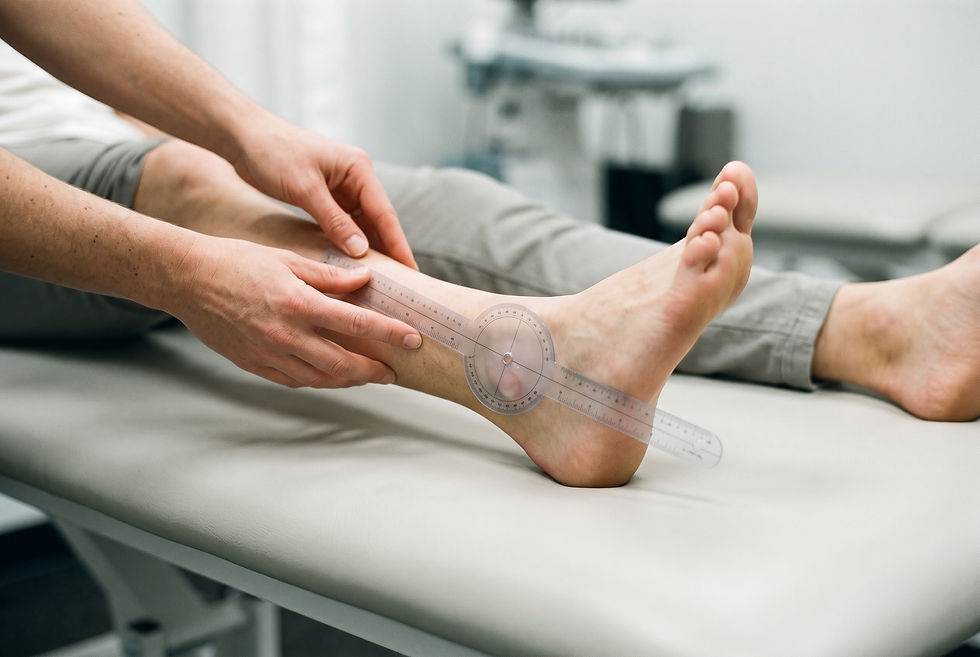
Other capacity-side factors are supported mainly by mechanistic reasoning rather than by direct evidence in athletes, and are listed here as hypotheses to be assessed individually. Plantarflexor strength and endurance determine how much of the load is borne actively by the muscle-tendon unit rather than passively by the fascia. The intrinsic foot muscles contribute to arch support and may share the load with the fascia during push-off. Control at the hip and trunk influences limb alignment and the direction of forces at foot contact. Each of these has biological plausibility, but studies in plantar fasciitis specifically are limited, and routine assessment of them is best justified as a way of identifying modifiable deficits rather than confirming a cause.
Properties of the fascia itself belong on the capacity side as well. In the meta-analysis of risk factors, imaging studies consistently showed that people with plantar fasciopathy, compared with controls, had a thicker and hypoechoic plantar fascia with increased vascular signal and perifascial fluid, and also a thicker heel fat pad and more frequent subcalcaneal spurs (van Leeuwen et al., 2016). These findings are associations measured in people who already had symptoms, so they cannot show whether the structural changes preceded the pain or followed it. They do indicate that the tissue itself is altered in symptomatic individuals, which is consistent with local tissue tolerance being a relevant variable. Previous episodes of heel pain, age, and the structural state of the fascia are plausible determinants of that tolerance, although athlete-specific data are limited.
Recovery capacity is the least visible component and the least studied. Collagen turnover in loaded tissue is influenced by the timing of loading and, plausibly, by energy intake, protein intake, and sleep. Insufficient spacing between high-load sessions, restricted energy availability, or sleep restriction during heavy training phases can plausibly reduce the rate at which the fascia repairs between sessions. No study of plantar fasciitis in athletes has isolated these factors, so they are best treated as contextual variables that modify the load-capacity balance and that are worth documenting.
What the Evidence Does and Does Not Support
It is useful to state where the evidence stands, because the clinical literature on plantar fasciitis often presents causal claims with more confidence than the study designs allow. Of the 51 observational studies included in the most comprehensive risk factor review, one was prospective, 46 were case-control, and four were cross-sectional (van Leeuwen et al., 2016). Case-control and cross-sectional designs can identify associations, but they cannot establish the temporal order needed to separate a cause from a consequence. A runner with altered loading mechanics, reduced dorsiflexion, or a thickened fascia on ultrasound may have had these characteristics before symptoms developed, or may have developed them because of pain, altered gait, or reduced activity. The finding from Ribeiro and colleagues that acute-stage runners show lower loading rates than chronic-stage runners illustrates that the relationship between mechanics and symptoms can change over the course of the condition.
A second limitation is population mixing. Many studies include athletes, recreational exercisers, and sedentary individuals in the same sample, and the risk profile appears to differ. The association with BMI was strongest in non-athletic participants, which suggests that for athletes the dominant factors may lie elsewhere, possibly in the dynamic loading pattern and the training context. Data specific to athletes are limited, particularly for non-runners; jumping, court, and field sports are under-represented relative to distance running.
A third consideration is that associations between a measured variable and the condition may reflect confounding by training exposure. For example, runners who train more may differ in both mechanics and injury risk because of the exposure rather than because of the mechanics. This is another reason why a systems view is a better fit for the data than a single-factor view: the data are consistent with several interacting contributors and do not identify one as primary.
The implication for practice is that the factors listed above should be treated as a structured set of hypotheses to examine in each athlete, weighted by the history and the findings, and not as a checklist of established causes. Training history, examination of the tissue, assessment of the capacity of the calf-Achilles complex and the foot, and review of the contextual factors are all informative, and in an individual athlete any of them may turn out to be the dominant one.
"Insufficient spacing between high-load sessions, restricted energy availability, or sleep restriction during heavy training phases can plausibly reduce the rate at which the fascia repairs between sessions."
Treatment Approaches
Treatment options for plantar fasciitis can be grouped by what they are designed to do. Some reduce symptoms or load in the short term, and others aim to increase the tissue's capacity to tolerate load. The two groups are complementary, and the clinical task is to sequence them according to the athlete's stage, symptoms, and competition demands. Current clinical practice guidelines for plantar heel pain from the Orthopaedic Section of the American Physical Therapy Association address the physical therapy management of nonarthritic heel pain (Koc et al., 2023).
Progressive loading. Because the chronic condition resembles a degenerative load-related tendon problem, progressive loading is a rational candidate for building capacity. A key randomized trial compared plantar fascia-specific stretching with high-load strength training in 48 patients with ultrasound-confirmed plantar fasciitis, both groups also receiving shoe inserts (Rathleff et al., 2015). The strength protocol consisted of unilateral heel raises with a towel placed under the toes, performed every second day with progressively increasing load. At three months the strength group had a Foot Function Index score 29 points lower than the stretching group (95% confidence interval 6 to 52). At one, six, and twelve months there were no significant differences between groups, which suggests that the main benefit was a faster early improvement. The trial did not specifically recruit athletes and its outcomes did not include return to sport, so extrapolation to athletes is an inference. Nevertheless, the protocol is simple, low-cost, and consistent with the principle of increasing tissue capacity, and it can be integrated with the athlete's strength training. Load, repetition range, and progression should be individualized, and symptom response in the 24 hours after loading is a practical guide to adjustment.

Stretching and mobility work. Calf and plantar fascia stretching are commonly prescribed and may be useful when restricted ankle dorsiflexion is identified as a relevant limitation in the individual athlete. The trial above suggests that stretching alone produces slower early improvement than high-load strengthening, and it is better regarded as one component of a program than as a stand-alone treatment.
Extracorporeal shockwave therapy. For athletes, the most directly relevant review is a systematic review of ESWT in athletes and physically active individuals, which included 56 studies and 1,874 participants (Rhim et al., 2024). Based on the level I studies, the authors concluded that ESWT may be effective alone for plantar fasciitis, and that in most studies participants were allowed to continue training and tolerated treatment with minimal side effects. They also noted that further high-level research is needed to define its role. These findings support ESWT as a reasonable option for athletes with persistent symptoms, including those who need to maintain training, with the caveat that the strength of the evidence varies across conditions and protocols.
Adjunctive physical therapy modalities. A 2026 network meta-analysis of 24 randomized trials (1,240 participants) examined physical therapy interventions delivered together with a home exercise program compared with the home exercise program alone (Li et al., 2026). Dry needling, low-level laser therapy, and manual therapy added to the exercise program were associated with short-term improvements in pain, and dry needling and taping with short-term improvements in function. Dry needling showed benefits that extended to the medium term. These trials were not restricted to athletes, and the review has the usual limitations of network meta-analyses with heterogeneous interventions, but the results suggest that such modalities are best used as adjuncts to an exercise program and not as replacements for it.
Orthoses, taping, and footwear. Foot orthoses, taping, and appropriate footwear modify the load reaching the fascia and are commonly used in clinical practice and in trials, including as a background intervention in the trial by Rathleff and colleagues. Their primary role is to reduce symptoms and load during the period in which capacity is being rebuilt. Because they do not change the capacity of the tissue itself, they are most useful when combined with loading and with correction of the training factors that contributed to the problem.
Corticosteroid injection. Injections are sometimes used for short-term pain relief. The histological findings described above raise the question of whether an anti-inflammatory treatment targets the relevant process in chronic cases, and the authors of that study suggested that repeated corticosteroid injections should be reconsidered given the potential for fascial rupture (Lemont et al., 2003). This caution is based on a small surgical series and should not be overstated, but in athletes who depend on the integrity of the tissue it supports a conservative approach, with injections reserved for selected cases after loading-based and other conservative measures and with attention to the training plan afterward.
Applying the Systems Perspective in Practice
Several practical points follow from the evidence and from the systems perspective.
Treatment directed at the tissue is legitimate in its own right. When the main limitation is the load tolerance of the fascia itself, progressive loading, symptom-guided load reduction, and the modalities described above address the problem directly, and a search for distant contributors should not delay them. The systems perspective adds to this by ensuring that other contributors, where present, are also identified and managed.
The assessment should include the history of load. A structured review of the six to eight weeks before symptom onset, covering training volume and intensity, surface, footwear, competition schedule, travel, sleep, and any change in body mass or energy intake, identifies candidate contributors that a physical examination will not. This review also informs the load modification needed during treatment.
The physical examination then establishes capacity. Useful elements include ankle dorsiflexion range with the knee extended and flexed, calf strength and endurance (for example through repeated single-leg heel raises), intrinsic foot muscle function, and hip and trunk control during a functional task relevant to the sport. These tests help to identify deficits to address and a baseline against which progress can be measured. Because the causal role of each deficit is uncertain, they should be interpreted in context and not as isolated explanations.
Load management during treatment should aim to keep the athlete training within symptom limits wherever possible. Complete rest reduces symptoms but also reduces the tissue's exposure to the loading that drives adaptation, so a period of rest followed by an unchanged return to training risks reproducing the original mismatch. A more rational approach is to reduce the most provocative elements (for example hard-surface volume, high-impact repetitions, or speed work) while maintaining other training and adding progressive loading of the calf and foot.
Return to full training should be criterion-based. Reasonable criteria include pain levels that are acceptable and stable during and after sport-specific loading, calf strength and endurance approaching those of the other side or of normative values for the athlete's sport, and a graded exposure to running or jumping volume and intensity that the athlete tolerates over successive weeks. Time since onset alone is not an adequate criterion.
Finally, the plan should address the contributors identified at the start. If a training load spike was the main factor, then the progression rules for the rest of the season should be revised. If footwear or surface changed, those should be reviewed. If capacity deficits were present, they should be addressed in the strength program. Without this step, the athlete returns to the same conditions that contributed to the original problem.
Conclusion
Plantar fasciitis in athletes is best understood as a load-related tissue problem that arises when the demands on the plantar fascia exceed its capacity to adapt and recover. The fascia is the site where the mismatch becomes symptomatic, and its own properties (structure, load tolerance, previous episodes) are part of the picture. The other contributing factors can include training exposure, movement mechanics, footwear and surface, the strength and mobility of the calf-Achilles complex and the foot, and the athlete's recovery. Their relative weight differs between athletes: in some the local tissue is the main limitation, in others the context is, and in many both contribute. The available evidence supports several of these factors as plausible contributors, notably the loading rate during running, body mass in the general population, and possibly ankle dorsiflexion, but it comes mostly from cross-sectional and case-control studies that cannot establish causation, and few studies have been conducted in athletes other than runners. This uncertainty is itself a reason to favor an assessment that examines the whole system in each athlete. On the treatment side, progressive loading has a clear rationale and some trial support, ESWT has supporting evidence in athletes, and adjunctive modalities, orthoses, and taping are best used to support the rebuilding of capacity, not to replace it. In practical terms, the aim of management is not only to resolve heel pain but to restore a load-capacity balance that allows the athlete to train and compete at the required level without recurrence.
---
Frequently Asked Questions
Q: Is plantar fasciitis an inflammatory condition?
In chronic cases, histological studies have described degenerative changes in the fascia (collagen fragmentation and myxoid degeneration) without clear inflammatory infiltrate, which is why the terms plantar fasciopathy and fasciosis are also used. The samples studied came from patients with long-standing symptoms who underwent surgery, so early-stage tissue may differ. In practice, this means that treatment of persistent cases should focus on loading and tissue capacity and not only on reducing inflammation.
Q: Should an athlete stop training completely when plantar fasciitis develops?
Complete rest is not usually necessary and may be counterproductive, because it reduces the loading that tissue adaptation depends on, and symptoms can return when training resumes at the previous level. A reasonable approach is to identify and reduce the most provocative training elements, such as high-impact volume, hard surfaces, or speed work, while continuing other training and adding progressive calf and foot strengthening. The exact modifications depend on the sport, the stage of the season, and the symptom response.
Q: Is strengthening or stretching more effective?
In one randomized trial, high-load strength training with towel-assisted heel raises produced greater improvement in function at three months than plantar fascia-specific stretching, although the groups did not differ at six and twelve months. The trial did not specifically recruit athletes, so the findings need to be applied with some caution. Stretching is still useful when restricted ankle dorsiflexion is identified, and the two approaches can be combined within a progressive program.
Q: Does shockwave therapy work for athletes with plantar fasciitis?
A 2024 systematic review of ESWT in athletes and physically active individuals concluded that, based on the higher-quality studies, ESWT may be effective alone for plantar fasciitis, and that most athletes were able to continue training with minimal side effects. The authors also called for further high-level research. ESWT is therefore a reasonable option for persistent cases, ideally combined with a loading program and with correction of the factors that contributed to the problem.
Q: Why does plantar fasciitis recur in some athletes?
Recurrence can occur when symptoms are reduced but the tissue has not regained adequate load tolerance, or when the contributors to the original load-capacity mismatch are not addressed, for example when the athlete returns to the same training load, footwear, or surface with unchanged calf and foot capacity. The available evidence does not identify a single cause of recurrence, but a systems-based review of training history, capacity deficits, and recovery, together with criterion-based return to full training, addresses the most likely contributors.
References
Johnson, C. D., Tenforde, A. S., Outerleys, J., Reilly, J., & Davis, I. S. (2020). Impact-related ground reaction forces are more strongly associated with some running injuries than others. American Journal of Sports Medicine, 48(12), 3072–3080. https://doi.org/10.1177/0363546520950731
Koc, T. A., Bise, C. G., Neville, C., Carreira, D., Martin, R. L., & McDonough, C. M. (2023). Heel pain – plantar fasciitis: Revision 2023. Journal of Orthopaedic & Sports Physical Therapy, 53(12), CPG1–CPG39. https://doi.org/10.2519/jospt.2023.0303
Lemont, H., Ammirati, K. M., & Usen, N. (2003). Plantar fasciitis: A degenerative process (fasciosis) without inflammation. Journal of the American Podiatric Medical Association, 93(3), 234–237. https://doi.org/10.7547/87507315-93-3-234
Li, Z., He, S., Wu, J., Zhu, Z., Chen, L., & Lu, W. (2026). Efficacy of physical therapy interventions delivered with home exercise programs for pain and function in plantar fasciitis: A systematic review and network meta-analysis of randomized controlled trials. Physical Therapy, 106(6). https://doi.org/10.1093/ptj/pzag056
Rathleff, M. S., Mølgaard, C. M., Fredberg, U., Kaalund, S., Andersen, K. B., Jensen, T. T., Aaskov, S., & Olesen, J. L. (2015). High-load strength training improves outcome in patients with plantar fasciitis: A randomized controlled trial with 12-month follow-up. Scandinavian Journal of Medicine & Science in Sports, 25(3), e292–e300. https://doi.org/10.1111/sms.12313
Rhim, H. C., Shin, J., Kang, J., Dyrek, P., Crockett, Z., Galido, P., Wade, C., Hollander, K., Borg-Stein, J., Sampson, S., & Tenforde, A. S. (2024). Use of extracorporeal shockwave therapies for athletes and physically active individuals: A systematic review. British Journal of Sports Medicine, 58(3), 154–163. https://doi.org/10.1136/bjsports-2023-107567
Ribeiro, A. P., João, S. M. A., Dinato, R. C., Tessutti, V. D., & Sacco, I. C. N. (2015). Dynamic patterns of forces and loading rate in runners with unilateral plantar fasciitis: A cross-sectional study. PLoS ONE, 10(9), e0136971. https://doi.org/10.1371/journal.pone.0136971
Riddle, D. L., Pulisic, M., Pidcoe, P., & Johnson, R. E. (2003). Risk factors for plantar fasciitis: A matched case-control study. Journal of Bone and Joint Surgery (American Volume), 85(5), 872–877. https://doi.org/10.2106/00004623-200305000-00015
Taunton, J. E., Ryan, M. B., Clement, D. B., McKenzie, D. C., Lloyd-Smith, D. R., & Zumbo, B. D. (2002). A retrospective case-control analysis of 2002 running injuries. British Journal of Sports Medicine, 36(2), 95–101. https://doi.org/10.1136/bjsm.36.2.95
van Leeuwen, K. D. B., Rogers, J., Winzenberg, T., & van Middelkoop, M. (2016). Higher body mass index is associated with plantar fasciopathy/'plantar fasciitis': Systematic review and meta-analysis of various clinical and imaging risk factors. British Journal of Sports Medicine, 50(16), 972–981. https://doi.org/10.1136/bjsports-2015-094695

Antonio Robustelli is the founder of Omniathlete. He is an international high performance consultant and sought-after speaker in the area of Sport Science and Sports Medicine, working all over the world with individual athletes (including participation in the last 5 Olympics) as well as professional teams in soccer, basketball, rugby, baseball since 24 years. Currently serving as Faculty Member and Programme Leader at the National Institute of Sports in India (SAI-NSNIS).


Comments