


(Un)Movement Screenings: Why Tests Like the FMS Fail to Capture How Athletes Actually Move

Updated: 1 day ago
Movement screening tools performed in static or highly constrained conditions—such as the Functional Movement Screen (FMS)—have gained widespread adoption in applied sport settings in the last years. Their appeal lies in apparent simplicity: standardized tasks, ordinal scoring systems, and the promise of identifying dysfunctional movement patterns or injury risk. However, this appeal rests on a fundamentally flawed assumption—that movement quality can be meaningfully assessed through isolated, decontextualized, and invariant tasks.
From a contemporary motor control and ecological dynamics perspective, this assumption seems to be based on extremely weak foundational rationale.
Human movement is not a fixed trait to be revealed under artificial constraints, but an emergent, adaptive process shaped by the continuous interaction between organismic, task, and environmental constraints. Within this framework, static screening tests provide neither valid nor useful information about how an athlete actually moves in performance contexts.
This article critically examines static and constrained movement screening—using the FMS as a representative example—through the lens of movement variability, degeneracy, and constraint‑led behavior, arguing that such tests fail to capture the essential properties of skilled movement.
Movement Is a Variable, Not a Template
Traditional screening approaches implicitly assume the existence of an optimal or correct movement pattern against which deviations can be judged. This view is incompatible with decades of research demonstrating that movement variability is not noise or error, but a functional and necessary feature of biological systems.
Bernstein’s seminal work on motor control highlighted the “degrees of freedom problem,” emphasizing that skilled movement emerges through flexible coordination rather than rigid pattern reproduction (Bernstein, 1967). Subsequent research has reinforced this view, showing that expert performers exhibit structured variability, allowing them to adapt to changing constraints while maintaining task success (Davids et al., 2003; Stergiou, Harbourne and Cavanaugh, 2006).
Static screening tests, by design, suppress this variability. They constrain joint motion, task goals, and environmental context, thus eliminating the very features that define adaptive movement. What remains is not a representation of how an athlete moves, but a snapshot of how they comply with an imposed task.
Degeneracy and Multiple Movement Solutions
A central concept completely ignored by static screening is degeneracy— that is the ability of structurally different elements to produce the same functional outcome (Edelman and Gally, 2001).
In movement systems, degeneracy allows athletes to achieve performance goals through multiple coordination strategies, depending on constraints such as fatigue, surface, speed, or opponent behavior.
From this perspective, there is no single "correct" squat, lunge, or reach pattern. There are context‑specific solutions that emerge under particular constraints. Screening tests such as the FMS, however, score movement based on conformity to predefined criteria, implicitly penalizing alternative—but potentially effective—solutions.
This approach conflates movement appearance (i.e. how a movement execution looks like) with movement function (i.e. how a movement responds to its primary objective), a distinction that is critical in both performance and injury research. Two athletes may display markedly different kinematics while achieving identical task outcomes and load distributions, yet static screening tools lack the resolution to distinguish between functional variability and maladaptive behavior.
Constraints Shape Movement
Ecological dynamics emphasizes that movement emerges from the interaction of constraints across three domains: organismic, task, and environmental (Newell, 1986). Performance‑relevant movement cannot be understood outside this interaction.
Static screening tests systematically remove or oversimplify these constraints:
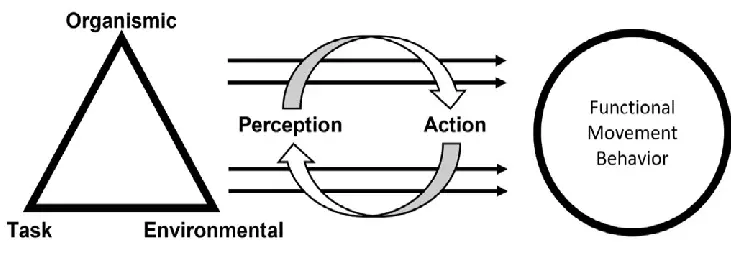
Task constraints are reduced to slow, non‑competitive, non‑time‑pressured actions
Environmental constraints are standardized or completely eliminated
Organismic constraints such as fatigue, emotional state, or injury history are ignored or treated as confounders rather than integral components
As a result, the movement observed during screening bears little resemblance to the movement expressed during training or competition. The athlete is not solving a meaningful motor problem; they are complying with an artificial one.
Beyond the Mobility–Stability Dichotomy
A further conceptual limitation of static movement screening lies in its reliance on the reductionist dichotomy of mobility versus stability as primary explanatory constructs. Screening outcomes are frequently interpreted as indicating that a given joint or segment “requires more mobility” or “lacks stability,” implicitly assuming that these qualities are intrinsic, fixed properties of anatomical structures.
However, contemporary motor control theory clearly demonstrates that mobility and stability are not joint‑specific traits, but emergent behaviors arising from the interaction between task demands, environmental constraints, and the performer’s intentions (Latash, 2012; Newell, 1986).
The same joint may express high apparent stability in one context and high mobility in another, without either expression being inherently deficient or superior.
From a dynamical systems perspective, movement solutions are organized at the level of the task goal, not at the level of individual joints (Kelso, 1995). Stability, in this sense, refers to the robustness of task performance under perturbation, not to the restriction of joint motion. Excessive emphasis on local joint stability may, in fact, reduce the system’s capacity to adapt, explore alternative coordination strategies, and redistribute load when constraints change (Stergiou, Harbourne and Cavanaugh, 2006).

This adaptability is underpinned by degeneracy, whereby structurally different coordination patterns can achieve the same functional outcome (Edelman and Gally, 2001; Latash, Scholz and Schoner, 2010).
Static screening tools such as the FMS fail to account for this principle by evaluating movement against predefined kinematic templates, implicitly privileging certain movement appearances over functional effectiveness. In doing so, they conflate movement form with movement function and overlook the fact that skilled performance is characterized by flexible coordination and controlled variability, not by a rigid joint behavior (Davids et al., 2003).
Prescribing “more mobility” or “more stability” based on static, decontextualized observations is therefore not only unsupported by empirical evidence, but conceptually incompatible with a variable‑centered understanding of movement. Movement expression cannot be inferred from isolated joint qualities; it must be understood as an adaptive process continuously reorganized in response to changing constraints and performance demands.
Injury Risk Prediction and Static Movement Screening
Beyond theoretical limitations, static screening tools have repeatedly failed to demonstrate meaningful predictive validity. Systematic reviews and meta‑analyses have shown that FMS scores do not reliably predict injury risk across athletic populations (Bahr, 2016; Moran et al., 2017). Even when associations are reported, effect sizes are small and clinically irrelevant.
More importantly, these tools provide no actionable insight into how an athlete adapts to changing constraints, manages load, or reorganizes coordination under stress. They do not inform training design, nor do they guide intervention beyond generic corrective exercises—often based on the same flawed assumptions.
In this sense, static screening represents a categorical error: attempting to infer dynamic, context‑dependent behavior from static, context‑free observations.
Toward a Variable‑Centered Understanding of Movement
If movement is understood as an adaptive process, assessment must shift accordingly. Rather than seeking to classify athletes as “good” or “bad movers,” practitioners should focus on:
Exploration of movement solutions under varying constraints
Stability–variability relationships across tasks and intensities
Adaptability in response to perturbations, fatigue, and environmental change
This does not imply abandoning assessment, but redefining it. Movement assessment should be embedded within representative tasks, preserving the informational constraints that shape behavior (Pinder et al., 2011). This way we will be able to get closer to better understanding the ways in which an athlete moves.

Conclusion
Static, constrained movement screening tests like the FMS are built on outdated assumptions about motor control and movement quality. By ignoring variability, degeneracy, and the role of constraints, they fail to capture the essence of athletic movement. Worse, they risk misleading practitioners into overvaluing appearance over function.
A contemporary, evidence‑based approach demands that we move beyond static templates and embrace movement as a variable, adaptive, and context‑dependent phenomenon. Until screening tools reflect this reality, their utility will remain limited at best—and illusory at worst.
References
Bahr, R. (2016) 'Why screening tests to predict injury do not work—and probably never will…', British Journal of Sports Medicine, 50(13), pp. 776–780.
Bernstein, N. A. (1967). The Coordination and Regulation of Movements. Oxford: Pergamon Press.
Davids, K., Glazier, P., Araújo, D. and Bartlett, R. (2003) 'Movement systems as dynamical systems', Sports Medicine, 33(4), pp. 245–260.
Edelman, G. M. and Gally, J. A. (2001) 'Degeneracy and complexity in biological systems', Proceedings of the National Academy of Sciences, 98(24), pp. 13763–13768.
Kelso, J. A. S. (1995). Dynamic Patterns: The Self‑Organization of Brain and Behavior. Cambridge, MA: MIT Press.
Latash, M. L. (2012) 'The bliss (not the problem) of motor abundance (not redundancy)', Experimental Brain Research, 217(1), pp. 1–5.
Latash, M. L., Scholz, J. P. and Schöner, G. (2010) 'Toward a new theory of motor synergies', Motor Control, 14(3), pp. 276–308.
Moran, R. W., Schneiders, A. G., Mason, J. and Sullivan, S. J. (2017) 'Do Functional Movement Screen (FMS) composite scores predict subsequent injury?', Sports Medicine, 47(11), pp. 2153–2163.
Newell, K. M. (1986). Constraints on the development of coordination. In M. G. Wade & H. T. A. Whiting (Eds.), Motor Development in Children (pp. 341–360). Dordrecht: Martinus Nijhoff.
Pinder, R. A., Davids, K., Renshaw, I. and Araújo, D. (2011) 'Representative learning design and functionality of research and practice in sport', Journal of Sport & Exercise Psychology, 33(1), pp. 146–155.
Stergiou, N., Harbourne, R. and Cavanaugh, J. (2006) 'Optimal movement variability', Human Movement Science, 25(4–5), pp. 561–571.

Antonio Robustelli is the mastermind behind Omniathlete. He is an international high performance consultant and sought-after speaker in the area of Sport Science and Sports Medicine, working all over the world with individual athletes (including participation in the last 5 Olympics) as well as professional teams in soccer, basketball, rugby, baseball since 23 years. Currently serving as Faculty Member and Programme Leader at the National Institute of Sports in India (SAI-NSNIS).


Comments