


Not All Load Is Equal: A Joint Mechanical Perspective on Rugby Performance

Updated: Aug 7
Two players complete the same training session. Both report a similar RPE, cover a comparable distance, and spend the same amount of time on the field. Yet one player leaves the session after repeated scrums, mauls and collisions, while the other accumulates high-speed running, decelerations and changes of direction.
Can we really assume they experienced the same load?
Although GPS and wearable technologies have significantly improved our ability to quantify training and match demands, practical approaches remain valuable when resources are limited or when practitioners wish to better understand the nature of the stresses accumulated during performance. The aim is not to quantify load but to improve interpretation of mechanical exposures.
What Traditional Load Monitoring Captures
Over the last two decades, load monitoring has become a cornerstone of performance management in rugby. Advances in GPS technology and wearable microtechnology devices have provided practitioners with unprecedented access to objective information regarding players' external load, including total distance covered, high-speed running, accelerations, decelerations, and collision-related activities (Cummins et al., 2013; Iwasaki et al., 2024). Combined with internal load measures such as session rating of perceived
exertion (sRPE), these tools have substantially improved the ability of coaches and sport scientists to quantify training and match demands and to inform decision-making processes.
However, despite their undeniable value, access to these technologies is not universal. Many practitioners operate in semi-professional or developmental environments where
resources must be carefully allocated and where advanced monitoring systems may not be available for every athlete or every training session. In these contexts, coaches are often
required to make programming decisions using a combination of observation, experience, and limited objective data.
Understanding not only how much load is accumulated, but also the nature of that load, may provide practitioners with additional insights to guide training prescription and athlete management.
Considering the variety of demands experienced during rugby participation, a joint mechanical perspective may help coaches better connect on-field exposures with strength training interventions.
Understanding Mechanical Stress in Rugby

In rugby, mechanical stresses arise from the unique combination of high-speed locomotion, frequent changes of direction, repeated decelerations, collisions, and static contact situations such as scrums, mauls, and rucks. Collision exposure should be considered a distinct mechanical stressor within rugby performance, given its contribution to both physical performance demands and injury burden throughout the season (Hendricks et al., 2019). Although direct quantification of joint loading typically requires sophisticated biomechanical analysis, practitioners can still benefit from understanding the predominant mechanical demands associated with different rugby activities.
For practical purposes, rugby activities can be viewed as exposing athletes to varying combinations of compressive, shear, rotational, and eccentric loading. While these categories do not represent discrete biomechanical entities and often occur simultaneously, they provide a useful framework for practitioners seeking to understand the predominant mechanical stresses associated with different rugby activities.
Compressive loading is commonly associated with actions involving axial force transmission, such as scrummaging, mauling, and prolonged contact situations. Scrummaging exposes front-row players to substantial axial and compressive forces transmitted through the cervical spine and trunk (Milburn, 1993).
Shear loading is frequently encountered during aggressive braking actions and rapid changes of direction, where adjacent body segments experience forces acting in opposing directions. High-intensity braking actions generate substantial horizontal force demands and are associated with increased mechanical stress across the lower limb during deceleration tasks (Harper et al., 2022).
Rotational loading occurs during multidirectional movements, evasive actions, and other tasks requiring control of forces acting across multiple planes of motion. Rugby athletes are regularly exposed to these demands, particularly during open-field play. Cutting and change-of-direction manoeuvres expose athletes to substantial multiplanar loading, including rotational demands across the hip, knee and trunk (Dos'Santos et al., 2018).
Finally, eccentric loading is a fundamental component of deceleration, landing, and change-of-speed activities. During these actions, muscles must absorb and dissipate large amounts of mechanical energy while maintaining movement control (Harper et al., 2022).
Of course, these loading categories rarely occur in isolation. Practitioners should identify the dominant exposure based on frequency, intensity, and relevance to the athlete's positional demands.
Rugby players are exposed to unique combinations of mechanical stress depending on their position, playing style, and match involvement. Therefore, rather than attempting to precisely quantify joint loading, practitioners may benefit from identifying the dominant mechanical stress profiles experienced by their athletes and using this information to guide training decisions.
A Practical Observation Framework Without Advanced Technology
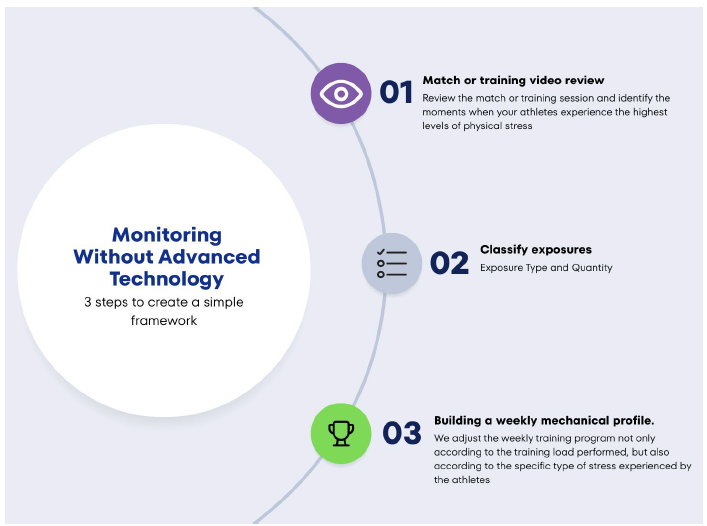
Step 1
Match or training video review.
Step 2
Classify exposures.
Exposure Type and Quantity
• Scrums
• Mauls
• Rucks
• Collisions
• High-intensity CODs
• High-intensity decelerations
Step 3
Building a weekly mechanical
profile.
The proposed framework is not designed to estimate the exact forces acting on individual joints, but rather to identify the predominant mechanical stressors experienced by athletes throughout training and competition (Fig. 1).
Rather than calculating exact joint forces, coaches simply need a practical way to identify the dominant stresses accumulated during play. We are seeking to understand which types of mechanical demands are most frequently encountered and accumulated over time. From a practitioner's perspective, this distinction is crucial. The objective is not to replace laboratory-based biomechanical assessments, but to develop a practical framework capable of translating match and training demands into meaningful strength and conditioning decisions.
While observing and categorising mechanical exposures, coaches can construct an individual mechanical profile that complements traditional load monitoring metrics and helps inform training priorities.
Understanding what type of stress an athlete is repeatedly exposed to may be just as important as understanding how much work they have performed.
Example of Mechanical Stress Profiles Across Rugby Positions
While forwards are typically exposed to greater compressive and collision-based demands through scrums, mauls, rucks and repeated contact situations, backs are generally characterised by higher exposure to deceleration, multidirectional movement and open-field running demands. Nevertheless, mechanical stress profiles are influenced not only by positional role, but also by playing style and tactical responsibilities.
From Mechanical Exposure to Strength Prescription
The practical value of identifying mechanical stress profiles lies not in describing what athletes experience, but in informing how practitioners prepare them to tolerate those demands. If training load monitoring aims to understand the stresses accumulated during performance, strength and conditioning should aim to develop the physical qualities required to repeatedly withstand those stresses.

Athletes exposed to predominantly compressive and collision-based demands, may benefit from training strategies that emphasise whole-body force transmission, trunk stiffness, neck strength, and the ability to maintain force production during prolonged contact situations. Developing trunk stiffness and the capacity to efficiently transfer force through the kinetic chain may enhance both performance and resilience to contact-related
stressors (McGill, 2010).
Furthermore, neck strength may play an important role in maintaining stability and force transmission during contact situations such as scrummaging and collisions, which represent key physical demands in rugby union (Quarrie and Wilson, 2000). Consequently, heavy bilateral strength exercises, particularly those that keep the load close to the athlete's centre of mass, together with trunk- and neck-focused training, may represent important components of their in-season physical preparation.
In contrast, athletes frequently exposed to high volumes of decelerations and braking actions may require greater emphasis on eccentric strength development and energy absorption capacity. Deceleration places substantial mechanical demands on the lower limbs and requires athletes to effectively dissipate momentum while maintaining movement control. The importance of eccentric strength development is supported by evidence showing that effective deceleration requires substantial energy dissipation and braking capabilities (Harper et al., 2022).
Consequently, eccentric-focused strength training, landing drills, and exercises that
challenge braking capacity may help support the physical requirements associated with these exposures.
Greater emphasis on eccentric-oriented training may be implemented during the off-season and pre-season periods, when the overall training structure allows for higher exposure to these stimuli.
Rotationally dominant athletes may present a different set of needs. Repeated exposure to multidirectional movements, cutting manoeuvres, and evasive actions requires effective force production and control across multiple planes of motion. Evidence suggests that efficient cutting performance relies on the ability to produce and control forces across multiple planes while maintaining appropriate trunk and lower-limb mechanics (Dos'Santos et al., 2019).
For these athletes, developing frontal and transverse plane strength, rotational control, and anti-rotation capacity may be particularly relevant.
This framework (Fig. 2) should not be interpreted as a rigid exercise prescription model. Rugby players rarely fit neatly into a single category, and individual playing style, tactical role, and match involvement often influence mechanical exposure more than positional labels alone. Instead, practitioners should use mechanical stress profiles as an additional layer of information when identifying training priorities.
Understanding the dominant mechanical stresses experienced by players can help practitioners make more informed decisions when planning strength training.
By considering not only how much work athletes perform, but also the type of stress they repeatedly encounter, practitioners may be better positioned to develop targeted and context-specific strength training interventions.
Practical Take-Home Messages
• External load and mechanical stress are not synonymous
• Rugby players may accumulate different mechanical exposures despite similar training volumes
• Mechanical stress profiles can complement traditional monitoring approaches
• Video analysis can provide valuable information when advanced technology is unavailable
• Strength training priorities should reflect the dominant mechanical demands experienced on the field.
This approach is not intended to replace GPS technology or biomechanical assessment methods. Rather, it offers practitioners a pragmatic framework for interpreting the dominant mechanical stresses experienced by rugby athletes and translating those observations into more informed strength training decisions.
---
Frequently Asked Questions
Q: What is the difference between external load and mechanical stress in rugby?
External load metrics — such as total distance, high-speed running, and collision counts — quantify how much work a player has performed. Mechanical stress refers to the type of force experienced by joints and tissues during that work: compressive, shear, rotational, or eccentric. Two players can accumulate identical external load scores while experiencing fundamentally different mechanical demands, depending on their position, role, and on-field actions.
Q: Do rugby forwards and backs require different strength training priorities based on their mechanical stress profiles?Generally, yes — but position alone is not the determining factor. Forwards typically accumulate higher compressive and collision-based loads through scrums, mauls, and rucks, which points toward trunk stiffness, neck strength, and whole-body force transmission as training priorities. Backs tend to experience greater deceleration and rotational demands, suggesting a greater emphasis on eccentric strength and multiplanar control. That said, playing style and tactical role can influence mechanical exposure as much as positional label, so individual profiling is more informative than positional generalisation.
Q: Can coaches assess mechanical stress without GPS or advanced technology?
Yes. The framework described in this article requires only video review of match or training footage. By observing and classifying the frequency and type of exposures — scrums, collisions, high-intensity decelerations, changes of direction — coaches can construct a meaningful mechanical profile for each player. The goal is not to calculate exact joint forces but to identify which types of stress are dominant, and to use that information to guide strength training decisions.
Q: How should mechanical stress profiles influence in-season strength training?
Mechanical stress profiles should function as an additional layer of information alongside traditional load monitoring. If a player is accumulating high compressive and collision loads during the competitive phase, strength training should prioritise exercises that develop trunk stiffness and force transmission capacity. If deceleration demands are dominant, eccentric-focused work and braking drills become more relevant. The framework is not a rigid prescription — it is a way of ensuring that what athletes train in the gym reflects the specific demands they face on the field.
References
• Cummins, C., Orr, R., O'Connor, H. and West, C. (2013) 'Global positioning systems (GPS) and
microtechnology sensors in team sports: A systematic review', Sports Medicine, 43(10), pp. 1025–1042.
• Dos'Santos, T., Thomas, C., Jones, P.A. and Comfort, P. (2018) 'Assessing muscle-strength qualities and asymmetries associated with change of direction speed performance: A systematic review', Journal of Strength and Conditioning Research, 32(12), pp. 3429–3447.
• Harper, D.J., McBurnie, A.J., Dos'Santos, T., Evans, M., Spiteri, T., Westerbeek, R., Osgnach, C., McFarland, A., Dobbin, N. and Jones, B. (2022) 'Biomechanical and neuromuscular performance requirements of horizontal deceleration: A review with implications for random intermittent multi-directional sports', Sports Medicine, 52(10), pp. 2321–2354.
• Hendricks, S., Till, K., den Hollander, S. and Savage, T.N. (2019) 'The epidemiology and associated performance effects of collision injuries in rugby union', Sports Medicine, 49(7), pp. 1021–1030.
• Iwasaki, Y., Tsukahara, T., Ueno, Y., Kido, Y., Yamamoto, M., Hasegawa, N. and Okamoto, T. (2024) 'Relationship between the contact load and time-loss injuries in rugby union', Frontiers in Sports and Active Living, 6, Article 1395138. doi:10.3389/fspor.2024.1395138.
• Milburn, P.D. (1993) 'Biomechanics of rugby union scrummaging', Sports Medicine, 16(3), pp. 168–179.
• McGill, S.M. (2010) 'Core training: Evidence translating to better performance and injury prevention', Strength and Conditioning Journal, 32(3), pp. 33–46.
• Quarrie, K.L. and Wilson, B.D. (2000) 'Force production in the rugby union scrum', Journal of Sports Sciences, 18(4), pp. 237–246.
• Dos'Santos, T., McBurnie, A.J., Donelon, T. and Thomas, C. (2019) 'A qualitative screening tool to identify athletes with high-risk movement mechanics during cutting', Journal of Strength and Conditioning Research, 33(5), pp. 1374–1383.

Francesco Sarno is a Strength and Conditioning Coach working with Amatori Napoli Rugby in Italy Serie A. His professional interests include load monitoring, strength development, and the application of evidence-based training strategies in semi-professional sport environment.


Comments